
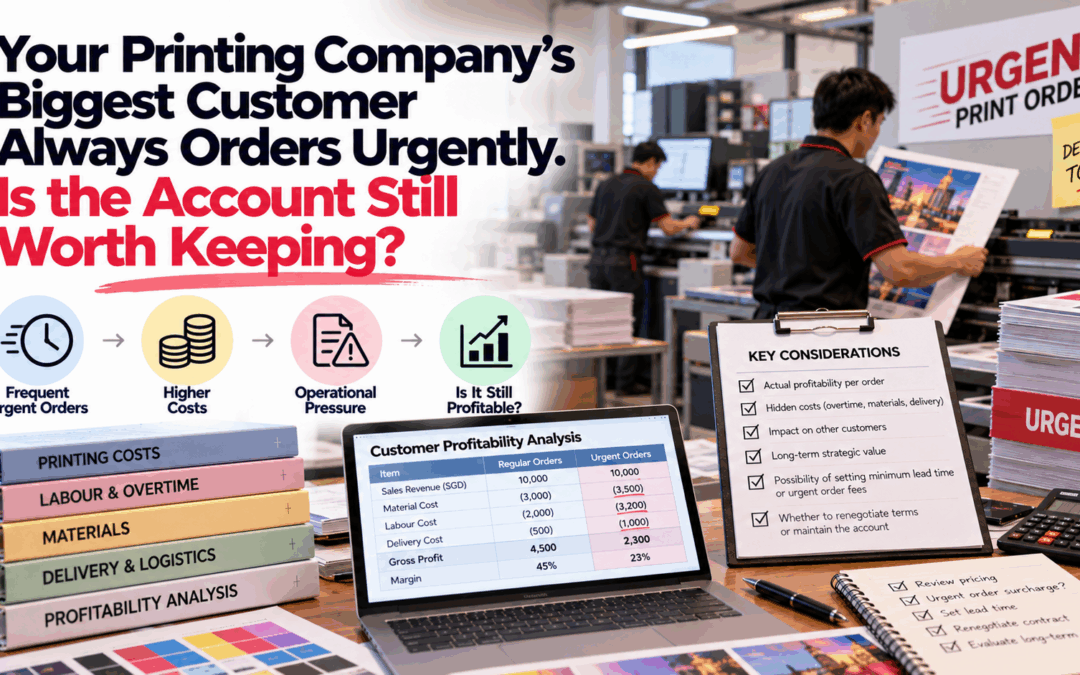
Your biggest customer sends another urgent order. The artwork arrives late, the paper is not in stock, and the finished materials need to reach several locations tomorrow. Your production manager rearranges the schedule, employees stay back, and someone books an express delivery.
The job goes out on time. The customer is pleased, and the invoice adds another substantial amount to monthly sales. Yet the extra spending is scattered across overtime, supplier charges and transport bills, making it difficult to see what the order actually earned.
An urgent customer can be commercially valuable. Reliable demand, prompt payment and repeat business may justify a flexible service. The question is whether your pricing and operating arrangements reflect the resources that flexibility requires. Before deciding to keep, reprice or reduce the account, establish what remains after the rush costs are counted.
Define What Makes the Orders Urgent
A short lead time does not always create an expensive job. If the required stock is available and the press has capacity, a quick turnaround may fit comfortably into production. Another order with the same deadline could require a complete rescheduling of work.
Record the circumstances behind the urgency. Identify when the order was placed, when usable artwork was approved and what changed after quotation. Distinguish the customer’s requested delivery date from the date your team had everything needed to begin.
This helps separate unavoidable commercial demands from preventable delays. A customer may consistently provide late artwork, but your internal approval process or quotation turnaround could also contribute.
The response should address the actual cause. Charging more for every short-lead-time order may miss an opportunity to improve the process, while treating every rush as routine can leave genuine additional costs unrecovered.
Measure the Account Beyond Monthly Revenue
Start with the customer’s net sales after discounts, credit notes and agreed adjustments. Then connect those sales to the costs of the jobs that generated them.
Include materials, outsourced finishing, additional labour, transport and other directly traceable spending. Review whether standard job-cost reports capture rush charges or place them in general overhead accounts where they become less visible.
Use consistent costing across customers. If one account is charged with actual delivery costs while another receives an average allocation, the comparison may reflect the method more than the commercial reality.
Prepare both a job-level view and a monthly account summary. A customer may place several profitable routine orders alongside a few expensive emergencies. Understanding that mix gives you more options than labelling the whole relationship good or bad.
See How a Promising Job Margin Can Shrink
Consider a hypothetical print order invoiced at S$10,000. Under the original production plan, materials, outside finishing and other job-specific costs total S$6,000. The job would leave S$4,000 towards fixed payroll, premises, equipment and profit.
The compressed deadline then creates additional spending. Overtime costs S$900, urgent material sourcing adds S$450, extra setup and spoilage cost S$350, and express delivery adds S$300. Assume each amount is incremental and has not already been included in the original S$6,000.
The additional cost is S$2,000, reducing the contribution to S$2,000. The invoice remains S$10,000, but the amount available to support the rest of the business has halved.
This example excludes tax and any effect on other orders. It does not establish that the job should have been rejected. It shows why revenue and the original estimate are insufficient for assessing the outcome.
If this pattern repeats, the account may deliver far less than management expects even while it remains the company’s largest source of sales.
Trace the Cost of Interrupting Production
Printing schedules often depend on sequencing. Jobs using similar paper, ink or finishing arrangements may be grouped to reduce setup time and waste. Inserting an urgent order can disrupt that plan.
Ask production to record meaningful interruptions. These could include an additional machine changeover, unused setup materials or work that has to be moved to an outside supplier. Focus on changes that affect resources rather than attempting to price every minor inconvenience.
Check whether the resulting costs have already been captured elsewhere. If overtime covers the disrupted schedule, do not automatically add a second estimate for the same labour. A credible analysis distinguishes observed spending from estimated operational effects.
Review the pattern over several jobs. One difficult order may be exceptional; repeated interruptions suggest that the account needs a different production or pricing arrangement.
Consider Other Orders That Lose Their Slot
When capacity is available, urgent work may add contribution without displacing anything. When a press or finishing line is fully occupied, accepting one job can affect another.
Assess the realistic alternative use of the constrained capacity. If another profitable order is turned away, its lost contribution matters to the decision. If it is merely moved to a later slot without extra cost or loss of business, the financial effect is different.
Use evidence rather than assuming every interruption creates lost sales. Keep records of rejected enquiries, outsourced work and additional costs incurred to protect existing delivery commitments.
Also consider the effect on service reliability. Repeatedly moving other customers’ jobs can weaken relationships over time, but that risk should not be presented as a precise monetary loss without support. Record it separately from costs you can substantiate.
Check Whether Volume Discounts Still Match the Work
A large customer may receive discounted prices because management expects efficient, repeatable production. That logic becomes weaker if orders arrive in small batches with frequent specification changes.
Compare the assumptions behind the discount with actual ordering behaviour. An annual sales commitment does not necessarily provide the same production efficiency as consolidated orders and reliable schedules.
Look at quantities per run, the number of deliveries and the frequency of artwork changes. A high annual invoice total can still require disproportionate setup, administration and transport.
The discussion may therefore concern the conditions for the discount as much as the base price. A planned-order rate and an expedited-order rate could better reflect the service, provided the terms are clear and agreed.
Make Artwork Changes and Reprints Visible
Late changes can create costs after the original quotation has been accepted. A revised file might require new preparation work, another proof or replacement plates. Changes made after production starts can also make completed output unusable.
Keep a version and approval record for each job. Identify what was approved, when production began and which subsequent changes were requested. This provides a factual basis for discussing additional charges.
Distinguish customer changes from corrections needed because your company did not meet the agreed specification. The cost analysis should not assume that every reprint is chargeable to the customer.
A consistent approval process helps both parties. It allows the customer to understand the consequence of a change before instructing it and gives your team a clearer basis for deciding whether the deadline remains achievable.
Compare Pricing Options Before Rejecting the Account
If the account’s contribution is too low, ending the relationship is only one possible response. The customer may be willing to pay for the speed and flexibility it relies on.
Consider a rush surcharge, minimum job charge or separate fees for additional delivery locations and late changes. Base the proposal on the resources required, rather than choosing a percentage solely because it is easy to apply.
A fixed surcharge may work for a predictable expedited service, while unusual jobs may need individual quotation. Establish what the charge includes and when further approval is required.
Using the earlier example, an additional S$2,000 would restore the original S$4,000 contribution amount, assuming it creates no further costs. It would not preserve the original contribution percentage. Management should be clear about which pricing objective it is pursuing and whether the market supports it.
Offer Planning Arrangements That Reduce the Rush Cost
Some customers have predictable campaigns but uncertain final content. It may be possible to reserve capacity or forecast material requirements before the artwork is complete.
Discuss a rolling schedule showing likely dates, quantities and specifications. Clarify which information is indicative and which creates a firm commitment. Your company should not purchase large amounts of special stock based on a forecast it has mistaken for an order.
Standardising commonly used materials or finishing options may also reduce lead times. Where the customer needs a specialised item, agree who bears the cost if it becomes obsolete or remains unused.
Reserved production capacity has value too. If you hold a slot that cannot be sold to someone else, assess how that commitment is priced and what happens when the customer does not use it.
Review Payment Behaviour Alongside Profitability
Urgent orders can require cash before the customer pays. Materials may need immediate settlement, overtime enters payroll and express carriers invoice promptly, while the customer remains on normal credit terms.
Track the account’s actual collection period and outstanding disputes. A customer that pays reliably may be easier to fund than one that repeatedly delays payment over small documentation issues.
Include additional commitments in the cash forecast. Revenue growth from the account can increase the amount tied up in receivables, particularly if several urgent orders arrive together.
Separate profitability from funding. A profitable job can still create a cash gap, while prompt payment does not turn an underpriced job into a profitable one. Both questions belong in the account review.
Set Clear Authority for Promising Deadlines
Sales staff may feel pressure to say yes before production has assessed the request. Once the deadline is promised, the business can feel obliged to absorb whatever cost is required to meet it.
Establish when a production review is needed before a delivery commitment is made. Relevant triggers might include unavailable materials, work outside normal operating hours or displacement of confirmed jobs.
Give the team a practical approval route. The person authorising the rush should see the expected price, additional costs and effect on the schedule. That decision should happen before the extra spending, not after the job is dispatched.
Record exceptions where management deliberately accepts a lower return for a specific commercial reason. This makes the decision visible and prevents a one-off concession from quietly becoming the customer’s permanent entitlement.
Assess What Would Happen If the Account Reduced or Left
An account showing a weak result after allocated overheads should not automatically be dropped. Some costs will remain even if its orders disappear, including premises commitments, equipment payments and parts of payroll.
Compare future receipts and costs that would actually change. Also assess whether released capacity can realistically be filled with better work and how long that would take. A hoped-for replacement customer is not the same as a confirmed order.
Consider a partial change before an all-or-nothing decision. Your business might continue accepting planned jobs while limiting certain rush requests, or agree a different service level at renewal.
Where there are existing commitments, review them before changing the arrangement. The commercial plan should reflect both the financial outcome and what the company has already agreed to deliver.
Use Account Reporting to Guide the Next Conversation
A useful account review brings together net sales, actual job costs, rush spending, production disruption and payment performance. It should explain which jobs work well and which conditions repeatedly reduce the return.
Take that evidence into the customer discussion. A proposal supported by examples of late changes, separate deliveries and additional production hours is easier to assess than a general claim that the account is demanding.
Royal Premier provides accounting and management reporting services, including financial analyses that support business decisions. Organised job records can help printing business owners understand customer contribution and compare the results of revised terms.
Your biggest customer may still be worth keeping. The stronger decision comes from knowing what its orders earn, what urgency costs and whether both parties can agree a workable service arrangement. A well-priced, well-planned relationship can remain valuable without requiring every deadline to be funded from your margin.
Recent Comments