
A Pilates Studio Adds Reformer Machines, but Its Popular Classes Are Already Full
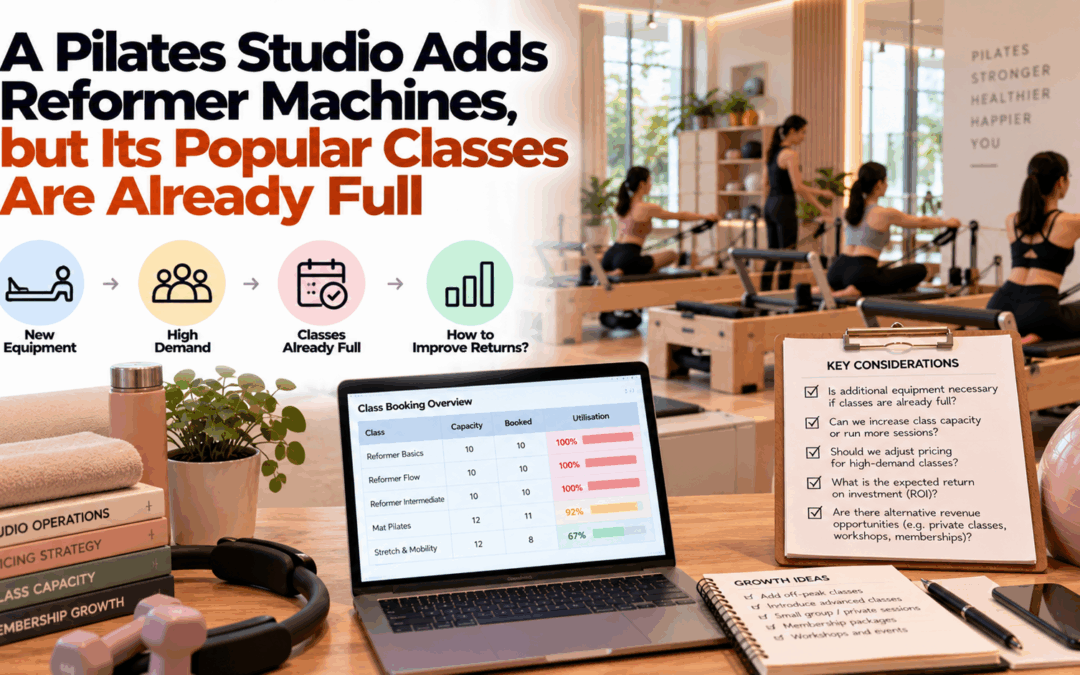
The evening classes fill quickly, weekend sessions attract waiting lists, and regular clients complain that they cannot book their preferred times. For the owner of a Pilates studio, adding reformer machines can look like a straightforward response. More machines should mean more places, more bookings and more revenue.
However, the investment only works if the studio can turn those additional places into worthwhile business. The room may not comfortably accommodate a larger class. Instructors may already be working their preferred hours. Meanwhile, machines sit unused during quieter parts of the day. A full Saturday morning class does not establish that equipment is the studio’s main constraint.
Royal Premier provides accounting and management reporting services that help businesses understand performance through financial information. For a studio considering expansion, the useful question is how the proposed equipment changes revenue, operating costs and cash requirements. That assessment starts with the timetable and customer behaviour, rather than the supplier’s quotation.
Find Out Where the Capacity Problem Actually Sits
A studio can be busy at particular times while having substantial unused capacity overall. Review bookings by day, time, instructor and class type. Separate consistently full sessions from those that fill only during promotions or particular weeks.
The pattern matters because different constraints require different responses. If clients want an evening session that already uses every machine, additional equipment might help, subject to space and teaching capacity. If clients specifically want one instructor, adding machines to another instructor’s session may not address their demand.
Also check whether the timetable offers the right mix of classes. Clients seeking beginner sessions may not be able to use available places in a more advanced class. Counting every empty machine as interchangeable capacity can overstate how easily the studio could accommodate them.
Before purchasing, describe the problem precisely. “We regularly turn away four additional paying clients from these specific sessions” provides a stronger basis for analysis than “the studio feels busy.”
Read the Waiting List Carefully
A waiting list is evidence of interest, but its headline length may exaggerate unmet demand. The same client may join several lists while intending to attend only one session. Others may accept a different class or decline a place when it becomes available.
Review unique clients, offers made and places accepted. Record how much notice clients receive, because a last-minute opening may be declined for reasons unrelated to demand. This gives the owner a clearer picture of which requests could realistically become additional attendance.
Then distinguish additional purchases from changes to existing usage. A client with an unlimited membership who attends more often may generate no immediate extra revenue. Someone using existing package credits may simply attend sooner. Another client might buy additional sessions if suitable places become available.
These outcomes can all matter commercially, but they should not be counted as identical new sales. Better availability may support retention, yet that benefit needs its own evidence rather than being assumed for every waiting-list entry.
Confirm That the Room and Teaching Model Can Support More Places
The fact that another reformer fits physically does not establish that the room can support a larger class. Consider access, movement around equipment, instructor visibility, ventilation and the studio’s operating requirements. Obtain the appropriate layout and safety advice before treating the extra capacity as available.
Discuss the proposed class size with instructors. A larger group may affect how the session is delivered, the attention clients receive and the time required between classes. If it requires another instructor or assistant, that changes the financial comparison.
Avoid building the forecast around a class format the studio would not be willing to deliver consistently. The business may have attracted clients because of its smaller groups. Increasing capacity without considering that expectation could weaken the service that made the popular sessions successful.
Some constraints may make a timetable change more practical than a larger class. The financial review should compare workable operating choices, with service quality treated as a requirement rather than an optional extra.
Calculate the Revenue From Additional Attendance
The advertised single-session price may be a poor measure of what each extra place earns. Clients may use discounted packages, introductory offers or memberships. Estimate the actual additional revenue supported by the expected customer mix.
For a simple planning model, identify how many extra paid sessions the investment is expected to generate, at what realised price and over which months. Keep complimentary attendance and existing membership usage separate. This prevents the forecast from assigning a full-price sale to every occupied reformer.
Ask whether the new capacity would move clients from other sessions. If an existing customer shifts from a quieter class to an expanded evening class, the studio has improved convenience but has not necessarily increased total revenue. The quieter session may become less economical as a result.
Compare the studio’s expected position with and without the investment. The difference is more useful than the gross revenue attributed to the new machines, particularly where clients can already find alternative slots.
A Simple Example Shows Why Demand Matters
Consider a hypothetical studio planning to add two reformers to an existing room. Assume the layout and teaching arrangements have been assessed as suitable. The total upfront equipment, delivery and installation cost is S$16,000.
Suppose the additional machines create two extra places across 40 suitable classes each month, giving 80 potential additional attendances. Management expects 60 genuinely additional paid attendances at an average realised price of S$30, producing S$1,800 in additional monthly revenue.
Assume additional attendance-related costs of S$3 per visit, or S$180, plus S$300 a month for extra maintenance, cleaning and administration. With no increase in rent or instructor fees under these specific assumptions, the estimated monthly operating contribution is S$1,320.
Dividing S$16,000 by S$1,320 gives a simple payback period of approximately 12 months. That is only an initial illustration: it excludes tax, financing, the time value of money and any gradual build-up in demand. It is not a forecast for a particular studio.
If only 30 additional paid attendances materialise, monthly contribution falls to S$510 under the same cost assumptions. Simple payback then extends to approximately 31 months. The equipment price has not changed, but the demand assumption has transformed the decision.
Include Costs That Change in Steps
Some costs increase gradually with attendance, while others rise once a threshold is crossed. An additional cleaning visit, a new instructor arrangement or a larger premises commitment may be required even if only a few extra places are sold.
Confirm how instructor compensation would work before expanding class sizes. A flat fee for the existing format may not apply to a larger group. Alternatively, adding sessions could require a minimum commitment that remains payable even when attendance is low.
The decision should reflect future costs that change because of the investment. Existing rent that stays unchanged is different from additional rent required to accommodate the machines. Where the expansion displaces another profitable activity, the contribution given up also belongs in the comparison.
Keep those assumptions visible. A forecast can appear attractive if it includes the additional revenue while leaving staffing and premises costs at their current levels without checking whether that is operationally possible.
Evaluate New Classes Separately From Larger Classes
Adding machines to existing sessions and adding sessions to the timetable are different decisions. The first may spread an existing instructor fee across more clients. The second usually creates another block of instructor time and potentially extends reception, cleaning or premises operating hours.
Prepare a separate estimate for each proposed session. Consider realistic attendance at that particular time rather than applying the average occupancy of the studio’s busiest classes. An early afternoon slot may attract a different customer group from an evening session.
If the new class draws clients away from existing sessions, include that movement in the review. It may still be worthwhile if it improves scheduling or frees capacity that other customers will buy. However, the forecast should show how the studio’s total attendance and contribution change.
This approach may reveal that the best next step is a targeted timetable adjustment rather than more equipment. It may also confirm that certain peak sessions have enough unmet demand to justify additional machines.
Test Retention Benefits Without Treating Them as Guaranteed
Improved booking access can have value even when existing members do not pay more immediately. A client who repeatedly fails to secure a preferred session may choose not to renew. Additional capacity could help preserve that relationship.
Look for evidence in cancellation reasons, renewal patterns and customer feedback. Identify whether booking difficulty is a recurring concern among members who leave, and whether those clients were seeking the sessions the new machines would expand.
Keep retention assumptions separate from direct additional sales. Otherwise, the forecast may count the same client twice: once as an extra paid attendance and again as a membership retained. Use a cautious scenario where the financial effect cannot yet be established.
A limited trial of additional sessions or revised booking arrangements may provide useful information. The aim is to learn whether improved access changes customer behaviour before committing to an investment whose return depends heavily on retention.
Keep Equipment Spending Separate From Package Cash
Selling packages can bring cash into the studio before the related sessions take place. That money may make an equipment purchase seem affordable, but management still needs to fund the classes clients are entitled to attend.
Prepare a cash forecast showing equipment deposits, final payments, delivery costs and any room alterations. Include the studio’s ordinary commitments and the costs of serving existing customers. Do not assume that all cash currently in the bank is available for expansion.
If financing is proposed, model the actual repayment dates alongside a slower demand scenario. The payments may begin before the extra places achieve the expected booking level. A profitable long-term idea can still create a difficult short-term funding gap.
Royal Premier’s management reporting services include forecasts and financial analysis. Bringing booking assumptions together with financial records can help management see both the potential return and the cash demands of the expansion.
Measure the Result Across the Whole Studio
If the investment proceeds, record the starting assumptions and review them against actual results. Track additional paid attendance, realised revenue, instructor costs and the use of the expanded sessions. Also watch whether quieter classes lose bookings.
Equipment occupancy alone is not enough. A new reformer can be frequently occupied without generating much additional income if most users have shifted from other sessions or are using unlimited memberships. Customer experience and retention should be monitored alongside the financial result.
Choose a review period that gives the revised timetable a reasonable opportunity to settle, while allowing problems to be addressed early. Note seasonal effects and promotional activity so that the owner does not attribute every change to the machines.
Where results differ from the plan, identify the reason. Weak demand, unsuitable class times and higher delivery costs call for different responses. A clear explanation is more useful than simply reporting that the investment is “below target.”
Buy Capacity the Studio Can Turn Into Value
Full classes are a positive signal, but the expansion case depends on what is preventing the studio from serving more customers profitably. Additional machines help only when the room, instructors, timetable and customer demand can support their use.
Before committing, establish which attendances would be genuinely additional, estimate their contribution and test the cash requirement under slower growth. Compare the equipment purchase with practical alternatives such as revised scheduling or a different class mix.
Speak with Royal Premier about its accounting and management reporting support if the studio needs clearer financial information behind its next investment. A decision grounded in booking patterns and reliable figures gives the owner a better basis for expanding capacity while protecting the service clients already value.
Recent Comments