
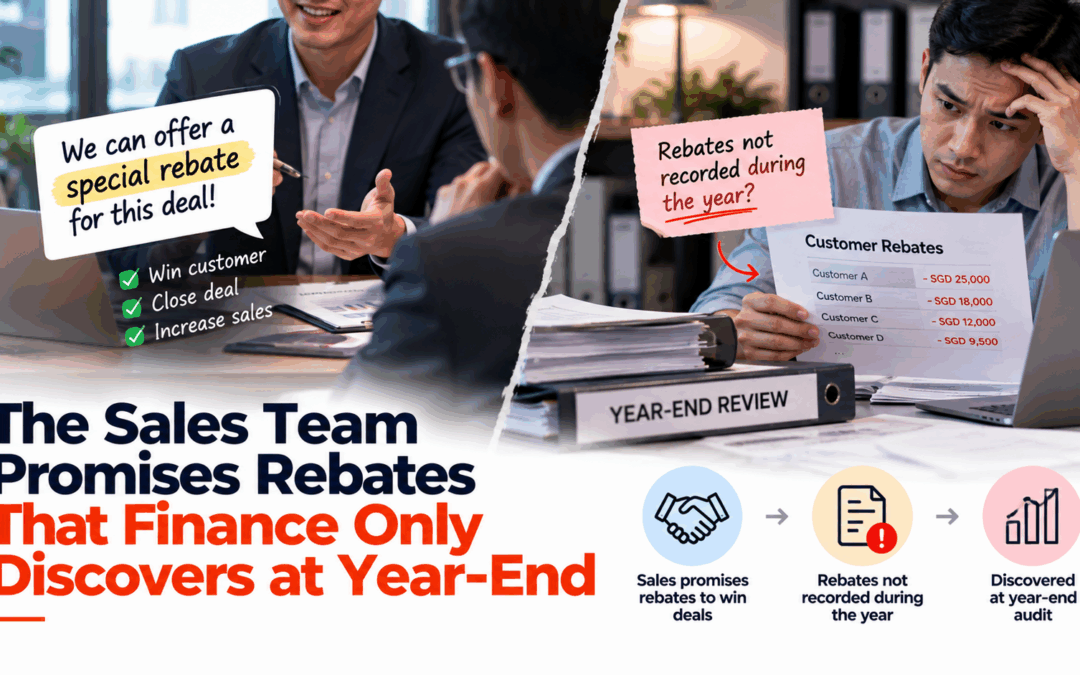
The sales figures look encouraging. A major customer has increased its orders, the account manager has met the annual target, and management expects the relationship to deliver a healthy contribution. Then, during the year-end review, the customer asks when its rebate will be issued.
Finance has no record of the arrangement. The sales team produces an email confirming a percentage rebate once annual purchases exceed an agreed amount. The customer has reached that threshold, but the monthly reports have continued showing sales without considering the concession.
The immediate task is to establish what the company promised and calculate the financial effect. The broader concern is how management assessed performance throughout the year without seeing the full commercial arrangement. Royal Premier PAC’s accounting and management reporting services support businesses in maintaining financial information for decisions like these. Complete reporting depends on rebate commitments reaching finance while the relevant sales are taking place.
A Rebate Is Part of the Commercial Deal
Rebates can help secure volume, encourage repeat purchases or support a longer customer relationship. The problem arises when the quoted selling price is visible in the accounting system but the related concession remains in an account manager’s correspondence.
An invoice might show the standard price even though the customer expects to receive some of that amount back later. Reviewing invoices alone can therefore give management an incomplete picture of the account’s value.
The first step is to establish the arrangement’s substance. Is it a rebate on purchases already made, a discount on future orders or payment for a separate service supplied by the customer? Different arrangements can require different accounting assessments.
For an ordinary sales rebate, the revenue assessment generally considers the amount the business expects to retain after the concession. Calling the payment a marketing allowance or loyalty reward does not, by itself, determine its treatment. Finance needs the underlying terms and supporting evidence.
Confirm Exactly What Was Promised
A short message such as “we can offer 3% if you reach the annual target” leaves important questions unanswered. Does the percentage apply to all eligible purchases or only purchases above the threshold? Are returned goods excluded? Does the calculation include delivery charges? Which dates define the qualifying period?
The parties may also disagree about whether the target refers to orders placed, goods delivered, invoices issued or amounts paid. A customer could believe it has qualified while the supplier’s calculation suggests otherwise.
Gather the signed agreement, emails, approved quotations and any amendments. Where the documents conflict, ask the responsible commercial manager to explain the history and seek clarification from the customer where necessary. Unclear contractual obligations may require legal advice.
An internal approval failure should also be investigated, but it does not automatically settle the company’s position with the customer. Management needs to assess the external commitment separately from whether an employee followed the company’s approval procedures.
Understand the Difference Between Two Similar Offers
A hypothetical distributor agrees to a 3% rebate if a customer’s eligible annual purchases reach S$1 million. By year-end, eligible purchases total S$1.2 million, excluding GST. The financial outcome depends heavily on the wording.
If the rebate applies retrospectively to all eligible purchases once the threshold is reached, the amount is S$36,000. If it applies only to purchases above S$1 million, the amount is S$6,000. Both arrangements could be described casually as a “3% annual rebate,” yet they produce very different results.
Suppose the account’s contribution before the rebate is S$120,000, with other costs unchanged. A S$36,000 rebate reduces that contribution to S$84,000, while a S$6,000 rebate reduces it to S$114,000. The example illustrates why a small percentage can have a meaningful effect on the value of an account.
Finance should not have to infer the calculation from an informal description. A worked example agreed during approval can help sales, finance and management understand the same offer before it reaches the customer.
Review the Estimate Before the Final Claim Arrives
Waiting for a customer to submit its claim can leave management reports incomplete for much of the year. Revenue standards require an assessment of variable consideration, including relevant estimates and the constraint intended to limit significant revenue reversals. The appropriate estimate depends on the arrangement and available evidence.
The supporting information may include purchases to date, order patterns, returns and credible expectations for the remaining period. An account approaching a threshold needs a different review from one that has little realistic prospect of qualifying.
For internal reporting, finance should document the assumptions behind the estimate and update them as circumstances change. A forecast increase in orders should have a basis, rather than simply reflecting the sales team’s target.
The objective is not to predict the final amount perfectly months in advance. It is to make a supportable assessment, identify uncertainty and explain changes. Discovering a rebate late should prompt a review of the relevant accounting periods, not an automatic decision to record everything in the month the claim arrives.
Make the Commitment Visible in the Monthly Reports
A useful customer report can distinguish invoiced sales, expected rebates, other agreed concessions and the resulting contribution. This gives management a clearer view of whether additional orders are improving the account’s economics.
The report should explain significant movements. A rising rebate estimate might result from increased purchases, a newly approved agreement, a change in the applicable tier or an error in the previous calculation. Each explanation has different implications.
Royal Premier’s management reporting services include financial analyses, variance reports and forecasts. These forms of reporting can support a clearer review of customer performance when the underlying commercial information is complete. Sales managers still need to communicate the agreements and changes that affect those reports.
A single rebate total at company level may conceal where the exposure is building. Linking the estimate to individual customers and agreements makes it easier to discuss the commercial reasons and identify exceptions that need management attention.
Check Whether Concessions Are Accumulating
An annual rebate may be only one part of the customer’s package. The account could already receive discounted prices, free deliveries, promotional support or credits for service issues. Different employees may approve these concessions without seeing their combined effect.
Reviewing each request in isolation can make the account appear more attractive than it is. A rebate that looks manageable against the standard price may be much more significant after other discounts and servicing costs are considered.
Before renewing or increasing the offer, prepare an account-level view of the concessions already provided. Identify which benefits overlap and whether the agreement permits them to be combined.
This also helps the sales team negotiate more clearly. If the customer wants a larger rebate, management can assess the full package and discuss the commercial exchange. The decision becomes better informed when everyone can see what the business is already providing.
Connect Sales Incentives With the Agreed Economics
A salesperson measured entirely on invoiced revenue may achieve a target even when associated concessions substantially reduce the account’s contribution. This does not necessarily mean the employee acted improperly. It may indicate that the performance measure overlooks part of the deal.
Management should review whether commission and bonus calculations consider rebates and other relevant adjustments. The treatment should be clear in advance and consistent with the employment or incentive arrangements.
For example, the company might use a performance measure that reflects approved concessions, supported by a defined process for later adjustments. The appropriate approach depends on the business, but employees should understand how customer deals affect their results.
Changing incentives retrospectively can create disputes and should not be treated as a simple remedy for missing information. The more useful response is to improve the reporting and agree clearer rules for future periods.
Keep a Shared Register of Rebate Arrangements
A central register gives finance a starting point for its review. Each arrangement should identify the customer, qualifying period, eligible products or services, thresholds, rates, calculation basis and approval reference.
The register should also show the responsible account manager, current estimate and settlement status. Links to supporting documents are important because a summary field may omit a qualification that affects the calculation.
Changes need their own record. If a manager lowers a threshold during the year or extends the qualifying period, finance should be able to see what changed, when it changed and who authorised it.
The register does not need to be complicated to be useful. A controlled shared document may be sufficient for a small number of agreements. What matters is that approved arrangements enter the process promptly and that someone is responsible for keeping the information current.
Reconcile the Rebate When It Is Settled
The year-end calculation is not the final control point. A rebate may be settled through a credit note, a cash payment or a deduction from the customer’s next remittance. Finance needs to connect that settlement to the amount already recorded.
Without that link, the business could account for the same concession twice. It could also continue chasing a customer for a deduction that represents an agreed rebate, creating an unnecessary dispute.
Prepare a reconciliation showing the estimated balance, the final agreed amount, settlements and any remaining difference. Explain adjustments rather than clearing them through an unrelated account to close the item.
Where the customer’s claim differs from the company’s calculation, establish whether the difference relates to eligibility, timing, returns or interpretation of the terms. A transparent calculation is more useful than exchanging totals without the underlying transaction detail.
Use the Discovery to Improve the Next Sales Cycle
Finding an unrecorded rebate at year-end should lead to a wider review of outstanding commercial promises. Ask account managers to confirm relevant arrangements, including amendments and commitments made outside the standard sales system.
The review should be framed around completeness. Employees need to understand that finance requires the information to report accurately and support commercial decisions. A process focused only on blame may make informal arrangements harder to identify.
For future offers, include finance in the approval process when the amount, structure or uncertainty warrants it. Require clear terms and a worked calculation before the customer receives the commitment. Once approved, the arrangement should move into the reporting process without waiting for the first claim.
These steps reduce the gap between what sales has agreed and what management sees. They also make customer discussions easier because the company can explain the calculation consistently.
Make Reported Growth Reflect the Deal Actually Agreed
Rebates can be commercially worthwhile when they encourage profitable demand and are reflected in the company’s plans. The difficulty is reporting growth on the invoice value while discovering the cost of that growth only after the year closes.
Management needs a clear view of approved commitments, realistic estimates and final settlements. That view supports better pricing, more meaningful customer comparisons and a more informed assessment of sales performance.
Royal Premier PAC provides accounting, bookkeeping and management reporting services for businesses seeking clearer financial information. Companies reviewing their rebate arrangements can discuss how those commitments should be captured in the records and reflected in management reports.
The practical starting point is to bring the commercial agreements and accounting records together. When sales and finance work from the same terms, management can judge an account by the value the company expects to retain, with the promised concessions already visible.
Recent Comments