
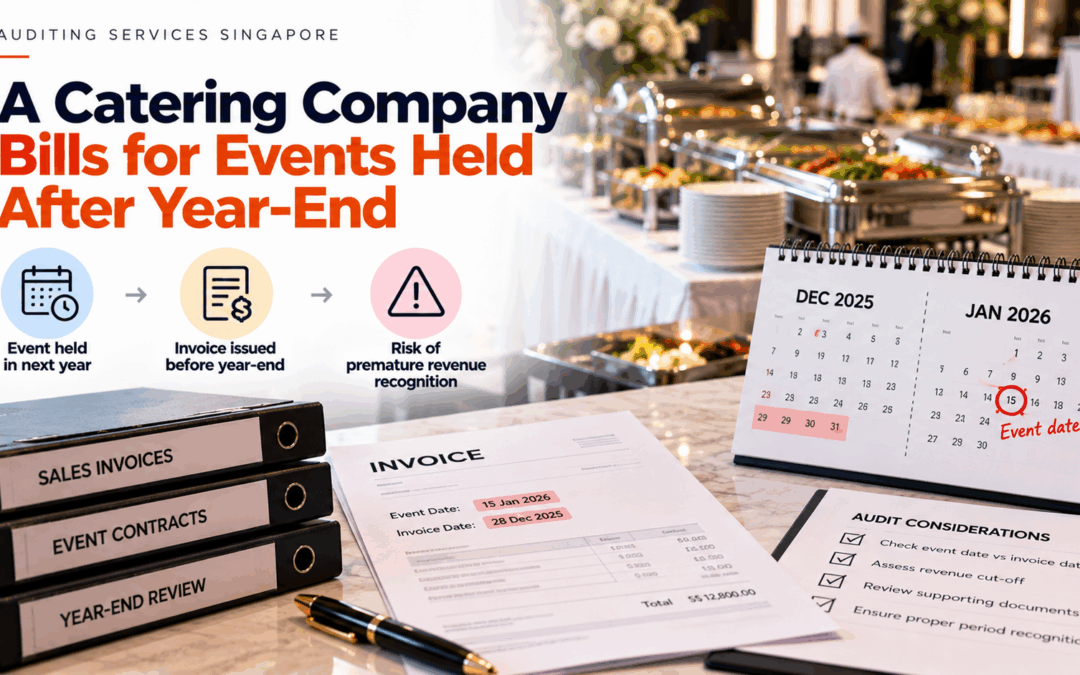
December can be a strong billing month for a catering company even when many of the events on its books will take place in January or February. Customers confirm menus, reserve dates and pay deposits, while the catering team begins arranging staff, ingredients and equipment.
Those bookings represent future business, but the invoices do not necessarily represent revenue earned before the financial year closes. If the accounting system records every invoice directly as sales, the company’s year-end results may include catering services it has not yet delivered.
For businesses considering auditing services Singapore, this distinction is an important part of preparing reliable financial statements. Royal Premier PAC provides financial statement audit services, examining financial reporting through an independent audit process. For a catering business, a clear connection between contracts, invoices and event records helps support the assessment of whether revenue belongs in the reporting period.
An Invoice Date and an Event Date Answer Different Questions
An invoice records a billing arrangement. It may request a deposit, an advance instalment or payment of a final balance. The event date helps establish when the catering service is provided, although the full contract must also be considered.
Revenue recognition under the revenue standards depends on the transfer of promised goods or services, rather than billing alone. For a straightforward catering package delivered at a single future event, issuing an invoice before year-end does not, by itself, demonstrate that the catering obligation has been fulfilled.
The distinction can be lost when accounting software automatically credits revenue whenever an invoice is created. That setting may work adequately for transactions where billing and delivery happen together, but advance event billing requires further review.
Management should therefore be able to explain both why the customer was invoiced and what had actually been delivered at the reporting date. These are related questions, but they are not interchangeable.
A January Event Can Create a December Balance
Consider a hypothetical catering company with a 31 December year-end. It agrees to provide a S$40,000 catering package for a corporate event on 20 January. The customer pays a S$20,000 advance in December, with the balance payable later. All amounts in this example exclude GST.
Assume that the package represents one catering obligation to be delivered in January and that no distinct service has transferred to the customer by 31 December. The December receipt would generally be recorded as a contract liability, reflecting the catering service still owed, rather than December revenue.
If an advance invoice remains unpaid, the analysis also considers whether the company has an unconditional right to payment. A receivable and a corresponding contract liability may arise where payment is due before performance. A quotation or provisional booking request should not automatically be treated in the same way.
The practical lesson is that the records need to distinguish the booking value, the amount billed, the amount collected and the service outstanding. A single “sales” figure cannot explain all four.
Preparation Does Not Automatically Mean the Customer Has Received a Service
Catering involves substantial work before guests arrive. Menus are discussed, suppliers contacted, rosters prepared and delivery routes planned. These activities can be essential to fulfilling the booking without necessarily representing separate services already transferred to the customer.
Management should examine what the customer has purchased. An integrated catering package may include preparatory activities that support the eventual event. A separately promised service, such as a distinct consultancy engagement, could require a different assessment if it genuinely meets the relevant criteria.
Describing part of the price as a “planning fee” does not settle that assessment. Neither does making an advance payment non-refundable. The contractual promises and the substance of the arrangement matter.
For the finance team, the useful starting point is a clear description of the deliverables. Where the treatment requires judgment, management should document its reasoning and discuss the accounting implications early, rather than relying on invoice descriptions to determine the outcome.
Build a Schedule Around Events, Not Just Invoices
An event-based schedule can make the year-end review more manageable. Each booking should have an identifier that links the signed quotation or agreement to invoices, receipts, credit notes and operational records.
The schedule should show the latest confirmed event date, contract value, amounts billed and collected, and the booking’s status at year-end. It should also identify cancellations, postponements and changes that could affect the figures. Where revenue has been recognised, the supporting explanation should be available.
This allows finance to identify December invoices relating to January events without searching through every customer email. It also helps reveal bookings that have been delivered but are still awaiting final billing.
The schedule should reconcile with the relevant ledger balances. If the booking system shows advances that cannot be found in the accounts, or the accounts contain customer balances with no identifiable event, those differences require investigation. A spreadsheet is useful only when it agrees with the underlying records or clearly explains the exceptions.
Review Transactions on Both Sides of Year-End
A year-end review should consider the risk of recording future events too early and the risk of omitting events already delivered. Focusing only on advance invoices can leave the second issue unnoticed.
For example, a catering company may complete a dinner on 29 December but wait until January to confirm additional guest charges and issue the final invoice. Finance should investigate the service delivered and the contractual entitlement at year-end, rather than assuming that January billing means all revenue belongs in January.
The operational event calendar is useful because it provides a separate starting point from the invoice listing. Comparing completed events with accounting entries can identify gaps that an invoice-only review would miss.
Management should also distinguish confirmed contract amounts from disputed additions. Extra meals, overtime and equipment charges may require further evidence. An operational note that additional work occurred does not necessarily establish the amount the customer has agreed to pay.
Keep Evidence of What Was Delivered
For businesses arranging auditing services Singapore, the quality of supporting records can make year-end discussions more efficient. The auditor may need more than an invoice to assess whether the recorded transaction reflects an event that occurred in the relevant period.
Depending on the circumstances, relevant records could include signed agreements, customer correspondence, delivery acknowledgements, event completion records and approved changes to guest numbers. Staff deployment and equipment records may provide supporting context, although no single internal document necessarily resolves the assessment.
The evidence should be consistent. An invoice dated December, an event calendar showing January and a delivery record with no date create questions that somebody must answer. Keeping the records together makes those inconsistencies easier to resolve.
Royal Premier’s financial statement audit services provide the context for an independent assessment of the financial statements. Management remains responsible for preparing the accounts and supporting its accounting judgments. Audit procedures are determined by the engagement’s risks and circumstances, rather than a universal document checklist.
Track Postponements Through Every System
A customer may originally book a December event and later move it to February. If operations updates the event calendar but finance retains the original date, the accounts may continue to reflect an outdated assumption.
The change should be linked to the original booking, with clear confirmation of the revised arrangements. Finance needs to know whether the advance remains applicable, whether additional charges have been agreed and whether any refund or credit is involved.
A changed event date should not simply overwrite the history without explanation. Keeping the original date and the subsequent amendment provides a clearer record of what management knew and when the booking changed.
Cancellations require their own review. The company should establish the contractual position, correspondence with the customer and any remaining obligations before deciding how to account for retained amounts. A cancelled status in the booking system is a prompt for assessment, not an automatic instruction to transfer every deposit into revenue.
Do Not Treat Event Costs as a Shortcut to Revenue
A catering company may have spent money on a future event before year-end. Supplier advances, ingredients and outsourced services can all appear in the records before the customer’s event takes place.
Those costs need their own assessment. Finance should establish what was received, what remains available and what the payment relates to. Paying a supplier does not, by itself, demonstrate that the customer has received the catering service.
The opposite shortcut is also problematic: moving every event-related cost forward simply because the event will happen later. Different expenditure can require different treatment, and amounts should not be carried forward without an appropriate basis.
Maintain supporting records that connect purchases and supplier payments to the event while preserving the nature of each transaction. This helps management explain both the revenue position and the related cost balances without forcing them into a predetermined margin.
Keep GST Timing Separate From Revenue Timing
For a GST-registered catering business, financial reporting and GST reporting can operate on different timing rules. Under the general GST time-of-supply rule, most transactions are reported by reference to the earlier of invoice issuance or receipt of payment, subject to the applicable rules and exceptions.
An advance invoice or payment may therefore trigger GST reporting before the catering revenue is recognised in the financial statements. Deferring revenue does not automatically mean GST should also be deferred.
The finance team should reconcile the treatment rather than trying to make both figures follow the same date. Advance invoices, contract liabilities and GST records should remain traceable to the relevant bookings.
This is particularly important where an accounting adjustment changes the revenue account after an invoice has already entered the GST reporting process. The adjustment needs to preserve the correct tax treatment and a clear audit trail.
Use the Same Review Throughout the Year
A catering company that reviews advances only at year-end may discover a large backlog of unclear bookings. Some events may have been delivered months earlier, while other balances relate to refunds, duplicate entries or bookings without updated dates.
A regular reconciliation can identify these issues while the people involved still remember the details. Finance can compare opening advance balances, new advances, amounts released following delivery, refunds and closing balances, with differences investigated promptly.
Management reporting should also distinguish confirmed future bookings from revenue already earned. Both are commercially useful, but they answer different questions. A strong booking pipeline indicates future activity, while recognised revenue reflects performance under the applicable accounting requirements.
Keeping those measures separate helps owners interpret a busy sales period without assuming that every invoice has already contributed to the year’s profit.
Prepare for the Audit With a Clear Booking Trail
Before the audit begins, management should be able to trace significant event balances from the customer agreement through to the accounting records. Future events need a clear status, completed events need delivery support, and changed arrangements need documented explanations.
The most useful preparation is a reconciled event schedule backed by accessible records. It gives the finance team a basis for identifying exceptions and provides a clearer starting point for audit enquiries. Unresolved matters should be highlighted with their supporting facts and management’s proposed treatment.
For catering businesses seeking auditing services Singapore, Royal Premier PAC offers financial statement audit services that can be discussed in the context of the company’s reporting needs. Explaining how bookings, advance billing and event completion move through the business helps establish the operational background to the audit.
The year-end objective is straightforward: the accounts should distinguish services already delivered from commitments that remain outstanding. When the event calendar and financial records tell a consistent story, management is better placed to explain both its reported performance and the work still to come.
Recent Comments