
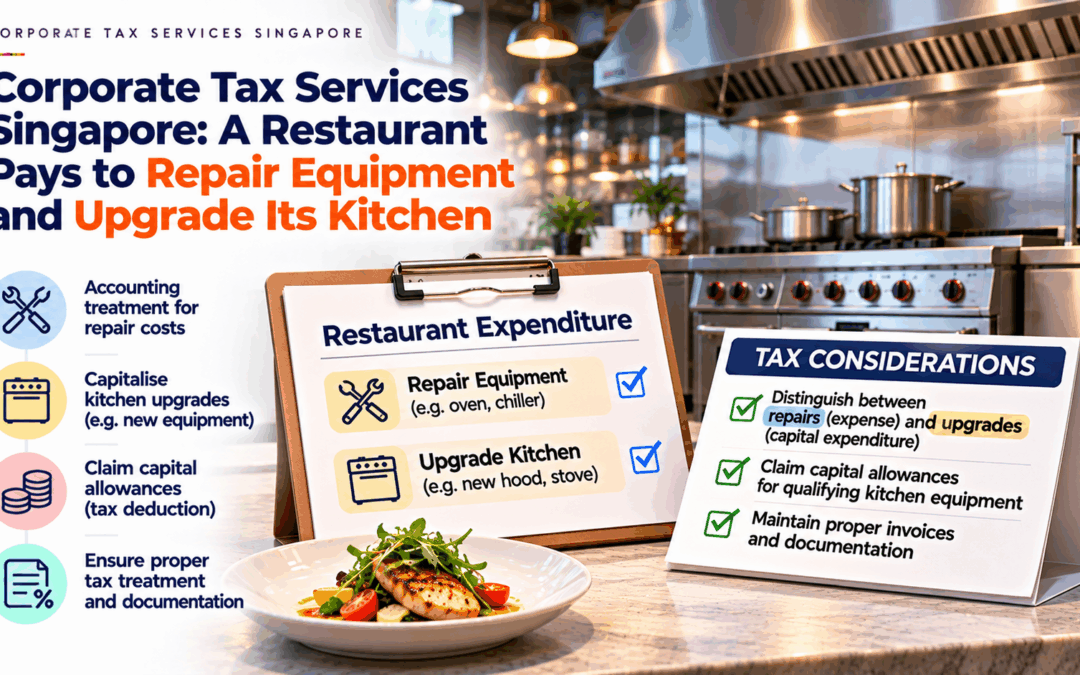
A restaurant closes its kitchen for several days to complete overdue work. A contractor repairs an existing chiller, replaces an oven and modifies the preparation area. The final invoice describes the entire project as “kitchen repairs and upgrading”, and finance posts the amount to one expense account.
When the corporate tax computation is prepared, that description leaves several questions unanswered. Which costs restored existing equipment? Which purchased new assets? Which related to the premises? The project may involve different tax treatments even though the work was completed together.
For restaurant companies considering corporate tax services Singapore, the first step is to establish what each part of the expenditure actually achieved. Royal Premier PAC provides corporate income tax preparation, filing and advisory services. A clear breakdown of the project gives the tax review a stronger foundation than a single invoice total.
Separate the Work Into Identifiable Items
Start with the contractor’s quotation, invoices and agreed scope. Identify the equipment repaired, items replaced and changes made to the kitchen itself. Include additional invoices from electricians, installers and other contractors involved in the project.
The accounting description should be specific enough for someone unfamiliar with the restaurant to understand the work. “Repair refrigeration compressor” provides more useful information than “kitchen works”. A separate line for a new oven helps distinguish the acquisition from servicing existing equipment.
Where the invoice is bundled, request a reasonable breakdown supported by the contractor’s records. Avoid inventing percentages solely to produce a preferred tax result. The allocation should reflect the actual goods and services supplied and reconcile to the total charged.
Understand the Difference Between Repair and Improvement
Work that restores existing equipment to its previous operating condition may have a different character from expenditure creating a new asset or materially improving what the business already has. The assessment depends on the facts, including the nature and extent of the work.
Replacing a worn component within an existing machine is different from purchasing an entirely new machine. However, labels such as “replacement” or “maintenance” do not settle the treatment by themselves. A substantial reconstruction can require closer examination even if the supplier calls it a repair.
Keep a short explanation of the fault, the work performed and the result. Maintenance reports, photographs and equipment specifications can support that explanation. The tax review should consider whether expenditure is revenue or capital in nature and whether the relevant deduction conditions are satisfied.
Do Not Let the Size of the Invoice Decide the Treatment
A large repair bill is not automatically capital expenditure, and a relatively inexpensive purchase is not automatically an ordinary repair. The purpose and nature of the expenditure remain important.
An emergency repair may be costly because specialist labour and parts are required at short notice. A smaller invoice might acquire a separate piece of equipment that the restaurant expects to use for several years. Comparing amounts alone can therefore lead to inconsistent treatment.
Management’s accounting policy for low-value items also does not, by itself, determine the tax outcome. Finance should preserve the details needed for a separate tax assessment, even where the bookkeeping system groups smaller purchases into an expense category.
Review New Equipment for Capital Allowances
New kitchen equipment should be reviewed separately from repair expenditure. IRAS explains that capital allowances may be available for qualifying plant and machinery used in the company’s trade or business, subject to the applicable conditions.
Accounting depreciation is not the tax deduction for the asset. The tax computation generally adds back depreciation charged in the accounts and considers the capital allowances available instead. The amount and timing of those allowances require their own assessment.
Maintain an equipment schedule containing the description, cost, acquisition details and relevant business use. Include supporting information for installation and other associated charges so that the qualifying cost can be evaluated. Do not assume that every item attached to the kitchen automatically qualifies as plant and machinery.
Consider Premises Works Separately
The kitchen project may include flooring, wall finishes, electrical works or changes to the layout. These items need to be assessed according to their actual nature rather than treated as part of the equipment purchase simply because they were necessary for the project.
Section 14N provides a deduction for qualifying renovation and refurbishment expenditure, subject to conditions and exclusions. Structural works do not qualify under that provision. Particular installations may require review to determine whether they fall within the relevant renovation rules or another treatment.
Provide plans and descriptions showing what changed. A quotation referring only to “electrical upgrading” may not explain the work sufficiently. The tax adviser needs enough detail to assess eligibility and ensure the same expenditure is not claimed under more than one provision.
Check the Relevant Period and Previous Renovation Claims
The renovation deduction has limits that require a review beyond the current invoice. From YA 2025, the qualifying expenditure cap operates over fixed three-year periods, with S$300,000 applying to YA 2025 to YA 2027.
The available capacity should therefore be checked against other qualifying expenditure incurred by the same company during the relevant period. A company operating several restaurants should not assume that each outlet has a separate cap.
The rules also provide a one-year write-off option for qualifying expenditure from YA 2025, subject to the applicable election requirements. Compare the available treatment with the company’s circumstances and retain the relevant claim history. An old calculation method should not be carried forward without checking the rules for the Year of Assessment concerned.
Use a Project Schedule to Guide the Review
Consider a hypothetical restaurant company that incurs S$100,000 on a kitchen project, excluding GST. The supporting breakdown identifies S$12,000 for restoring an existing chiller, S$38,000 for a new oven, S$35,000 for premises refurbishment and S$15,000 for structural alterations.
This breakdown does not establish the final tax deduction. It creates four areas for review: whether the chiller work qualifies as a deductible repair, whether the oven qualifies for capital allowances, whether the refurbishment meets Section 14N conditions and how the structural expenditure should be treated.
The company should not claim S$100,000 as repairs solely because that heading appears on the main invoice. Equally, it should not assume that every capital item receives no tax relief. Each category needs the relevant assessment, supporting documents and calculation.
Keep Accounting and Tax Schedules Connected
The financial statements and tax computation serve different purposes. Some expenditure may be capitalised in the accounts, while other expenditure is charged to profit. The tax review then determines the appropriate adjustments and claims.
Prepare a reconciliation showing where each project item appears in the ledger and how it is treated in the tax computation. Explain depreciation add-backs, capital allowance claims and any applicable renovation deduction. This makes omissions and duplicate claims easier to identify.
Royal Premier’s corporate income tax preparation services are relevant to this reconciliation. Supplying both the accounting entries and project documents helps the review address the actual expenditure rather than relying on broad expense headings or an incomplete fixed asset register.
Establish When Expenditure Was Incurred
Payment, invoicing and completion may occur at different times. A restaurant might pay a deposit before work begins, receive progress invoices during the project and settle the balance after reopening. Those dates need to be understood when determining the relevant tax period.
Retain the contract, progress claims, completion records and payment details. Identify any disputed amounts or work still outstanding. A payment made before year-end should not automatically be treated as a current tax deduction simply because cash has left the bank.
The timing assessment should follow the relevant tax rules for the type of expenditure. Finance should flag unusual arrangements early, including instalment purchases or work spanning accounting periods, so that the claim is supported by the underlying obligation and facts.
Identify Grants, Contributions and Recoveries
The restaurant may receive support from a landlord, supplier, insurer or government programme. Such amounts can affect the analysis and should be disclosed to the person preparing the tax computation.
Prepare a schedule showing the expenditure and each related contribution or recovery. Retain the terms explaining what the payment funds and whether any conditions apply. Avoid silently netting receipts against costs in a way that removes the supporting detail.
The appropriate treatment depends on the arrangement. Management should not assume that the gross invoice always forms the claim basis, or that every contribution is treated identically. A complete record allows the tax review to address both sides consistently.
Update Records for Equipment Removed
An upgrade may involve disposing of the old oven, chiller or other equipment. If finance records the new asset but leaves the old one in its schedules, the company may continue carrying an item it no longer owns or uses.
Obtain disposal, trade-in or scrapping records and identify any proceeds. Match the old equipment to its asset and capital allowance records. The tax consequences can include a balancing adjustment where applicable, so the original cost and tax history may remain relevant.
Keep the new purchase and old disposal traceable even where the supplier presents a single net amount. A trade-in allowance should not obscure the consideration for either transaction. Clear records also help explain changes in depreciation and the equipment register.
Prepare the Evidence While the Work Is Fresh
Contractors and restaurant managers are more likely to explain the work accurately during the project than many months later. Ask for detailed descriptions and retain relevant documents before the team moves on to its next operational priority.
Useful records include quotations, variations, invoices, completion confirmations, equipment specifications and photographs of significant changes. Identify the outlet and company that incurred the expenditure, especially where a group operates several restaurants.
Assign one person to assemble the project file. The purpose is to preserve the facts needed for accounting and tax decisions without repeatedly asking operational staff to reconstruct the same information. A complete file also makes later enquiries easier to address.
Use the Tax Review to Improve Future Budgets
A tax deduction or allowance can affect the project’s overall financial outcome, but it does not eliminate the initial cash requirement. Management should assess affordability using the full payment schedule and realistic assumptions about the company’s tax position.
Before approving another refurbishment, ask for quotations that distinguish equipment, repair work and premises changes. Include expected downtime, installation costs and any disposal or reinstatement commitments in the commercial budget.
Where corporate tax services Singapore are being considered, discussing a significant project before completion can help identify documentation needs and tax questions early. This supports a more informed decision without assuming that every item will qualify for immediate relief.
Make the Kitchen Project Explainable in the Tax Computation
A restaurant’s repair and upgrade programme can contain several types of expenditure with different tax consequences. Reliable treatment begins with understanding the work, identifying the relevant assets and retaining a supported allocation of costs.
Finance should connect those facts to the accounts, prior claims and the rules for the relevant Year of Assessment. The resulting computation should explain what has been deducted, what has been added back and which allowances or specific deductions have been claimed.
For restaurant companies seeking corporate tax services Singapore, Royal Premier PAC can discuss the records required for corporate income tax preparation and filing. Bring the project breakdown, equipment schedule and previous renovation claims so that the expenditure can be reviewed on a clear and consistent basis.
Recent Comments