
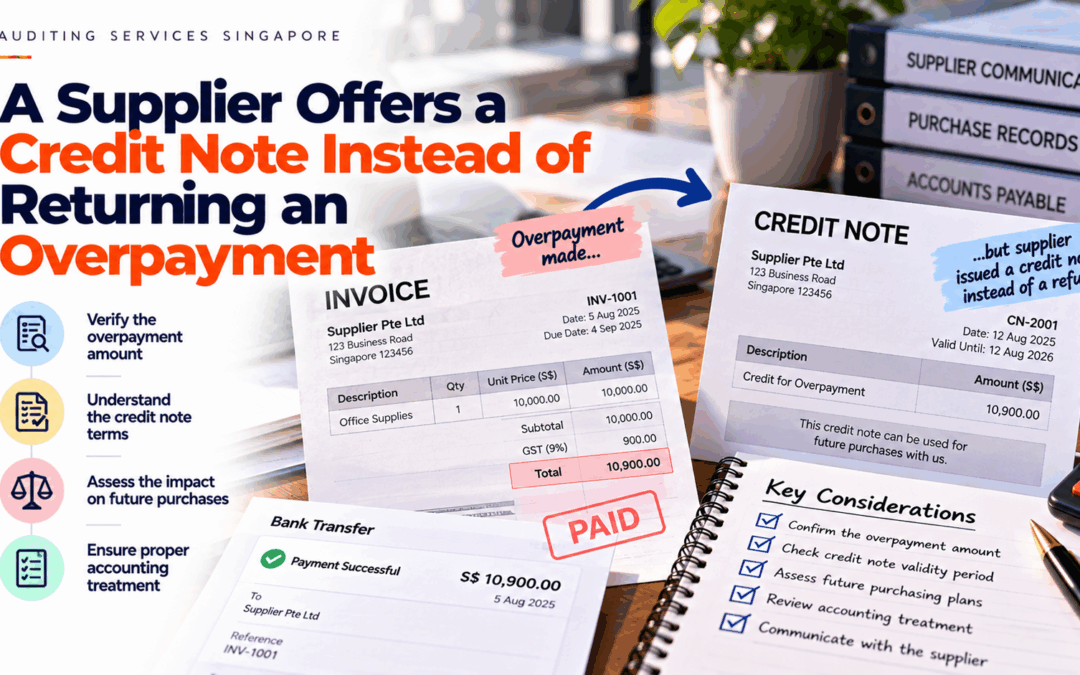
The supplier acknowledges that the company paid too much. Instead of returning the money, it sends a credit note and suggests deducting the balance from a future order. The purchasing team considers the matter resolved because the supplier has recognised the amount. Finance files the document, and everyone moves on.
Months later, the credit remains unused. The company has changed suppliers, demand has slowed or the next purchase does not qualify for the deduction. What appeared to be a straightforward correction has become cash tied up with another business.
For management, receiving a credit note is only one part of resolving an overpayment. The company also needs to understand what the document represents, how the amount can be recovered and whether accepting the proposed arrangement makes commercial sense. Royal Premier PAC’s accounting and management reporting services are relevant to keeping these balances visible and supported as circumstances change.
Establish Why the Overpayment Happened
Before deciding whether to accept a credit, trace the original payment. An overpayment might arise because the same invoice was paid twice, a deposit was not deducted from the final bill or an incorrect amount was entered into the payment system. Each situation needs to be reconciled to the underlying records.
There may also be no overpayment at all. A supplier statement can show an apparent credit because a payment has arrived before the related invoice is posted. If finance accepts that figure without checking the missing transaction, the company could incorrectly assume that money is available for future use.
Bring together the invoice, payment approval, bank transaction and supplier statement. Confirm the amount with the supplier and document the reason for the difference. This establishes a reliable starting point for deciding what should happen next and prevents a payment error from being confused with a genuine reduction in the purchase price.
Clarify What the Credit Note Represents
The heading on a document does not explain its full accounting or commercial effect. A credit note might reduce the price of goods, recognise returned items or simply acknowledge that the supplier holds excess cash. Those situations should not automatically receive the same treatment.
For example, a duplicate payment does not make the original purchase cheaper. If a company correctly recorded a S$12,000 invoice and then paid it twice, the extra S$12,000 needs to be tracked as an amount to recover or apply appropriately. Posting the supplier’s acknowledgement as a further reduction in the original expense could misstate the accounts.
Ask the supplier to explain how the document relates to its ledger and the original invoice. Finance should check whether the overpayment is already reflected in the company’s supplier account before posting anything further. Recording both the excess payment and a separate credit incorrectly can double-count the amount believed to be recoverable.
Confirm the Terms Before Accepting the Arrangement
A statement that the credit can be used “against future purchases” leaves important details unresolved. Can it be applied to any product? Must it be used in one transaction? Is there an expiry date, minimum order or restriction to a particular customer account?
The company should also clarify whether a cash refund remains available. A supplier’s preferred administrative process does not, by itself, establish the parties’ rights or replace the existing agreement. Where the amount is significant or the position is disputed, the contractual terms may need closer review.
Obtain the proposed arrangement in writing before treating the matter as settled. Record the amount, currency, relevant legal entities, permitted use and any agreed repayment date. A clear agreement gives purchasing and finance the same understanding and reduces the risk of discovering restrictions when the company eventually tries to use the balance.
Measure the Credit Against Realistic Purchases
A credit is easier to use when the company already expects to buy suitable goods from the same supplier. Historical spending provides some context, but the assessment should reflect current purchasing plans. A supplier that was essential last year may no longer be part of the business’s preferred supply chain.
Consider a hypothetical company with a S$24,000 overpayment. It expects qualifying purchases of S$4,000 per month from the supplier, and the full credit can be applied without restrictions. On those assumptions, utilisation would take approximately six months. If expected purchases fall to S$1,000 per month, the period extends to approximately two years.
That difference matters for cash planning and exposure to the supplier. Management should ask procurement to identify actual expected orders rather than relying on a general assurance that the company will eventually use the credit. Uncertain demand should remain visible in the assessment.
Avoid Spending More Simply to Recover the Balance
A supplier may offer to apply the credit only if the company places a larger order. This can make recovery appear attractive while creating a new cash commitment. Management needs to assess the proposed purchase on its own merits.
Suppose the company holds a S$10,000 credit, but using it requires a S$30,000 order. The company would still need to pay S$20,000, before considering delivery or other costs. If it only needs S$8,000 of the goods, the arrangement could replace one unresolved balance with excess inventory and additional spending.
Compare the total cost, expected use and alternatives. Buying unnecessary items to clear an old credit may worsen the original problem. The purchasing decision should remain subject to normal approval, even when the supplier presents the credit as an opportunity that should be used quickly.
Show the Difference Between a Refund and Reduced Future Payments
A cash refund and a supplier credit affect liquidity differently. A refund puts money back into the company’s bank account. A credit may reduce a future payment, but only when an eligible purchase occurs and the deduction is accepted.
The cash forecast should reflect the expected settlement method. If management expects to use a credit against a future invoice, the forecast can show the resulting reduction in that payment. It should not also include a separate cash receipt for the same amount.
Timing needs attention too. A credit expected to be used in December cannot fund payroll in September. Finance should distinguish confirmed refunds, planned offsets and balances with no clear recovery date so that management does not mistake an acknowledged amount for available cash.
Keep the Balance Visible in the Accounts
An overpayment can become difficult to monitor when it sits as a debit balance inside accounts payable. A summary report may combine it with amounts owed to other suppliers, leaving management unaware that a separate recovery issue exists.
Maintain a schedule showing the supplier, original payment date, amount outstanding, supporting documents and expected settlement route. Identify whether the company expects cash, future goods or services, or application against a particular invoice. The appropriate accounting classification depends on the underlying rights and circumstances.
Financial statement presentation also requires care. An amount recoverable from one supplier should not simply disappear against liabilities to unrelated suppliers. Where financial assets and liabilities are involved, offsetting is subject to specific conditions. The convenience of a net total in the accounting system is not enough to determine the reporting treatment.
Assign One Person to Follow Through
These balances often remain unresolved because responsibility is split. Purchasing manages the supplier relationship, finance records the credit and treasury wants the money returned. Each team may assume that another person is handling the next step.
Assign an owner who can coordinate the commercial decision and accounting follow-up. That person should know when the next eligible order is expected, whether a refund has been requested and what action is needed if the supplier does not respond.
Royal Premier’s bookkeeping, reconciliation and management reporting services provide a relevant basis for discussing how supplier balances are monitored. Management still needs to approve settlement decisions, but a consistent reporting process can ensure that old credits remain on the agenda instead of disappearing into routine ledger totals.
Review Recovery When Circumstances Change
A supplier’s written acknowledgement is useful evidence, but it does not guarantee that the company will receive cash or obtain goods of equivalent value. Recovery can become less certain if the supplier stops responding, changes its product range or struggles to fulfil orders.
The company’s own plans can also change. Closing a branch, discontinuing a product or moving to another supplier may remove the purchases that were expected to absorb the credit. A previously reasonable utilisation plan then needs to be reassessed.
At each reporting review, consider whether the recorded balance remains supported and whether an accounting adjustment is necessary under the applicable framework. The assessment should reflect the nature of the balance and current evidence. Age alone does not determine the outcome, but an unchanged explanation repeated month after month deserves challenge.
Agree on a Practical Settlement Route
The commercial discussion need not be limited to accepting the entire credit or demanding immediate repayment in full. Depending on what both parties agree, the company might request a partial refund, a defined repayment schedule or application against invoices already due.
Any arrangement should identify amounts and dates clearly. An agreement to refund “when possible” offers little basis for a cash forecast. Similarly, an intended deduction should be confirmed before the payment team reduces a supplier transfer and inadvertently creates a dispute about an unpaid invoice.
Where different companies within a group are involved, do not assume that one entity can use another’s credit. Confirm the parties’ agreement and the accounting consequences before transferring or applying the amount. Shared ownership or a familiar trading name does not make separate legal entities interchangeable.
Close the Matter With Evidence
A promise to apply a credit is not the same as evidence that it has been applied. When the company places its next order, check the supplier’s invoice and statement to confirm that the correct deduction appears. The payment approval should show the amount remaining after the agreed credit.
For a refund, match the bank receipt to the original overpayment and update the outstanding schedule. If recovery is partial, retain the unresolved amount with its next action and expected date. Avoid closing the entire item because one payment or deduction has occurred.
Finally, investigate the control failure that caused the overpayment. Duplicate invoice checks, deposit reconciliation and clearer payment references may prevent a repeat. Recovering the money resolves the immediate issue; correcting the process reduces the chance of creating another balance.
Turn an Acknowledged Credit Into a Clear Outcome
A supplier credit note can be a practical way to settle an overpayment when the terms are clear and planned purchases will use it promptly. It becomes less useful when it carries restrictions, depends on uncertain orders or encourages spending the company would otherwise avoid.
Management should be able to explain what is outstanding, why it remains recoverable and how it is expected to be settled. That explanation should connect the supplier’s confirmation with purchasing plans, accounting records and the cash forecast.
If supplier credits and overpayments keep carrying forward without a clear outcome, discuss the reconciliation and reporting process with Royal Premier PAC. Bring the original payment records, supplier statements and correspondence so that the accounting position can be reviewed and management can decide its next commercial step.
Recent Comments