
The Productivity Report Looks Fantastic Until Someone Asks the Next Question
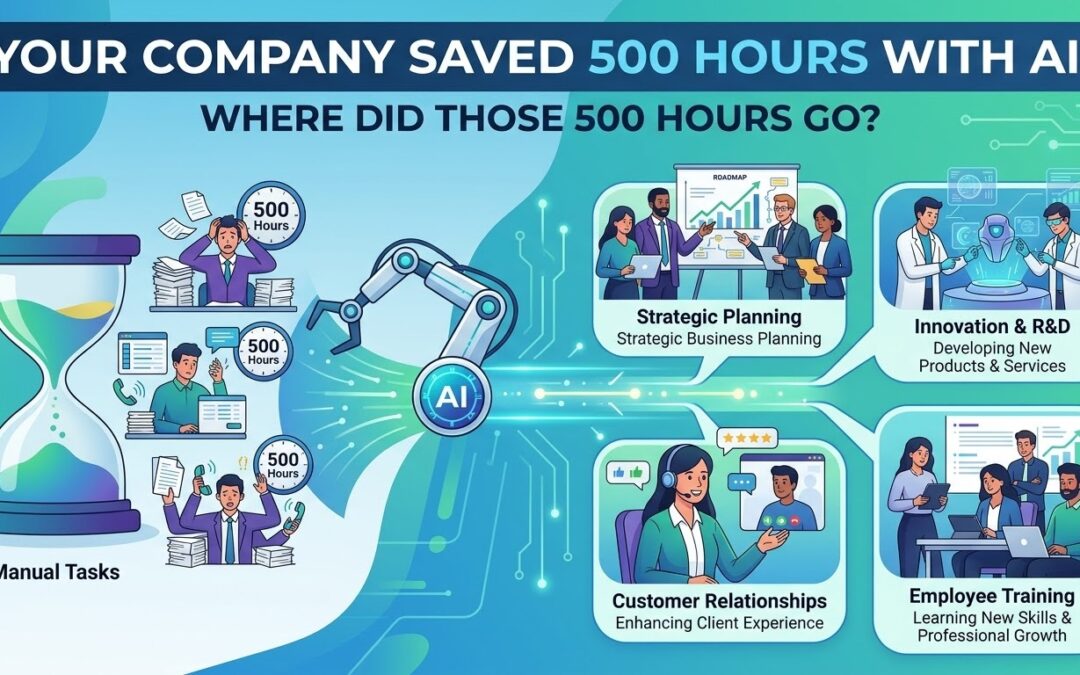
Your company has spent the past year introducing artificial intelligence into everyday work. Employees now use AI to draft emails, summarise documents, prepare first versions of reports, analyse information, answer routine customer enquiries and complete administrative tasks that previously consumed hours. Management eventually calculates that these tools are saving approximately 500 employee hours every month. It sounds like a major productivity achievement. Five hundred hours is more than twelve full 40-hour working weeks of capacity returned to the business every month. Yet when management looks at the wider organisation, something feels strange. Payroll has not fallen. Overtime has barely changed. Customer response times look similar. Employees still say they are busy, and some departments are requesting additional headcount. If AI genuinely saved 500 hours, where did those 500 hours go? This question is becoming increasingly important because measuring how quickly an individual task can now be completed is not the same as proving that the company itself has become more productive.
Singapore Businesses Are Already Moving Beyond the AI Experiment
This is no longer a theoretical management question. AI adoption is already changing how Singapore employees perform their work. The Ministry of Manpower reported in April 2026 that 28.5% of firms had started adopting AI, although only 3.8% had actively integrated AI into their core business processes. Among firms using AI, 70.7% reported improvements in worker productivity, while only 6.2% reported reduced headcount. Firms were more likely to redesign existing jobs or create new AI-related roles than simply remove employees. This tells business leaders something important. AI productivity does not automatically appear as fewer employees. In many organisations, the more relevant question is what employees and businesses actually do with the capacity that technology creates.
Saving Time on a Task Is Not the Same as Saving Time for the Company
Suppose an employee previously spent three hours preparing a weekly management report. AI helps the employee complete the first draft in 30 minutes, apparently saving two and a half hours. It is tempting to record those two and a half hours as productivity savings. But what happens next matters more than the calculation itself. Perhaps the employee spends another hour checking the AI-generated output because some figures need correction. Perhaps the manager sees that reports are easier to produce and asks for three additional versions. Perhaps the employee uses the remaining time to answer emails, attend meetings or complete work that had previously been delayed. The original task certainly became faster, but the business has not necessarily captured the full two and a half hours as usable capacity. Management needs to distinguish between a task becoming quicker and the organisation actually converting that time into measurable economic value.
Five Hundred Hours Does Not Automatically Mean Twelve Fewer Employees
This is where productivity discussions can become misleading. If a company saves 500 hours across dozens of employees, management cannot simply divide those hours by the monthly working hours of an employee and conclude that several jobs are no longer required. The savings may be fragmented across the organisation. One employee saves 15 minutes preparing an email, another saves 30 minutes reviewing a document, while another saves two hours each week preparing a report. Those fragments may be valuable, but they do not automatically combine into complete positions that can be removed. This is consistent with Singapore’s current experience. MOM’s 2026 findings indicate that AI is affecting how jobs are performed more than it is causing broad reductions in employment, with job redesign more common than headcount reduction. The opportunity therefore lies in redesigning work around the capacity created rather than assuming every saved hour translates directly into lower payroll.
Employees Usually Fill Empty Time Faster Than Management Expects
Work has a remarkable ability to expand into available capacity. An employee who saves 45 minutes preparing a report does not normally sit at the desk doing nothing for the remaining 45 minutes. There are emails to answer, documents to review, customers to contact, meetings to attend and tasks that have been postponed. This can be positive because AI may allow employees to complete work that the company previously lacked capacity to perform. However, management should know what is happening. If 500 saved hours are quietly absorbed by hundreds of small activities without any deliberate decision about priorities, the organisation may struggle to demonstrate what its AI investment actually achieved. The company has technically saved time while failing to direct that time towards its most valuable opportunities.
AI Can Make Low-Value Work Faster Without Making It Valuable
Imagine employees spend ten hours every month producing an internal report that almost nobody reads. AI reduces preparation time to two hours. The company celebrates an eight-hour productivity saving, but another question should come first: why is the report being produced at all? Automating unnecessary work can make an inefficient process look technologically advanced without improving the business. Companies should therefore use AI implementation as an opportunity to question existing activities. Which reports are still useful? Which approvals are genuinely necessary? Which meetings lead to decisions? Which data is being collected simply because someone requested it five years ago? Before using AI to perform an activity faster, management should ask whether the activity still deserves to exist.
Faster Work Can Accidentally Create More Work
One of the more interesting consequences of productivity technology is that cheaper and faster production can increase demand. When preparing a detailed report required six hours, management may have requested it once a month. If AI reduces the task to 20 minutes, managers may begin requesting weekly reports. Marketing teams that previously produced ten pieces of content may now produce fifty. A finance team that previously analysed five scenarios may be asked to analyse twenty. Employees can therefore become busier even though every individual task is faster. This is not necessarily bad if the additional output creates genuine value, but it means management should not assume that faster tasks will automatically create spare capacity. Sometimes AI removes work. Sometimes it encourages the organisation to create much more of it.
The First Question Should Be What Changed After AI Was Introduced
Management should avoid evaluating AI solely by asking employees how much time they believe they saved. A stronger assessment looks at what changed in business outcomes. Did customer response times improve? Can finance close the monthly accounts earlier? Are managers receiving information sooner? Did the company process more transactions without increasing headcount? Are employees spending more time with customers? Has overtime fallen? Can the company support higher revenue with the same administrative resources? Has error frequency improved or deteriorated? These questions move the discussion from theoretical time savings to operational outcomes. AI creates meaningful productivity when the organisation can do something better, faster, cheaper or at greater scale because of the technology.
Revenue Per Employee Can Tell Part of the Story
Consider a company with 50 employees and S$10 million in annual revenue. After introducing AI, it grows to S$12 million without increasing headcount. The business may have captured genuine productivity improvement even though payroll did not fall. Each employee is effectively supporting more economic activity than before. Alternatively, suppose revenue remains S$10 million, headcount remains 50, overtime remains unchanged and operating expenses rise because the company is now paying for several AI subscriptions. In that situation, management should investigate where the promised productivity gains appeared. Revenue per employee is not a perfect measurement because industries and business models differ significantly, but it illustrates why company-level outcomes matter more than simply adding together employee estimates of minutes saved.
Cost Reduction Is Only One Way to Capture AI Value
A company does not need to reduce headcount for AI to create economic value. Imagine a growing business that previously expected to hire five additional administrative employees over the next two years. If AI and better processes allow the company to handle that growth with its existing team, the financial benefit appears as avoided future cost rather than immediate payroll reduction. Another business may use saved capacity to improve customer service, perform deeper analysis or develop new products. Singapore’s MOM data similarly suggests that current AI adoption is more commonly associated with productivity improvements and job redesign than widespread headcount reductions. Management should therefore define the intended benefit before judging whether an AI project succeeded. Cost savings, growth capacity, service quality and decision-making improvements are different objectives and should be measured differently.
Saved Time Should Have a Destination Before It Is Created
If management expects AI to save 500 hours, it should decide what those hours are supposed to become. Perhaps 200 hours will support additional customer-facing work. Another 100 hours could reduce overtime, 100 could support financial analysis and the remaining 100 could allow the business to grow without immediately adding headcount. The exact allocation will vary, but the principle matters. Capacity without a destination is easily absorbed into everyday activity. A company that intentionally reallocates saved time has a much better chance of converting AI productivity into business value than one that simply gives employees tools and hopes something improves.
The Finance Department Is a Good Place to See the Difference
Finance teams provide an excellent example because many repetitive tasks can potentially be assisted by automation and AI. Employees may spend less time categorising transactions, preparing reconciliations, producing draft explanations, compiling management reports or reviewing large volumes of information. If those efficiencies are captured properly, finance professionals can spend more time analysing margins, monitoring receivables, investigating unusual cost movements, improving forecasts and helping management understand the numbers. The objective should not simply be to make accountants complete the same workload faster. It should be to change the mix of work so that less employee time is consumed by repetitive preparation and more is available for judgement, analysis and decision support.
Faster Financial Reporting Has Value Only If Someone Uses It
Imagine AI and automation allow management accounts to be prepared five days earlier every month. That sounds valuable, but the benefit depends on what happens next. If management receives the report earlier but still waits three weeks before reviewing it, the faster preparation creates little practical improvement. If management instead uses earlier information to identify deteriorating margins, late-paying customers or rising expenses sooner, the time saving becomes commercially useful. This distinction applies throughout the business. Technology can accelerate the production of information, but management must accelerate the decisions that follow. Otherwise, the organisation simply creates reports faster while continuing to operate at the same decision-making speed.
AI Can Shift the Bottleneck Instead of Removing It
Consider a process where employees previously spent four hours preparing a document and one hour waiting for managerial approval. AI reduces preparation to 20 minutes, but approval still takes two days because the manager has dozens of requests waiting. The bottleneck has moved. Improving the first stage does not necessarily improve the entire process because total completion time is still determined by the slowest critical stage. Companies should therefore measure processes from beginning to end rather than celebrating isolated improvements. If AI makes document preparation ten times faster but customers still wait the same number of days for an answer, management should investigate what happens after the AI-assisted step.
The Same Problem Appears When AI Is Added to Old Approval Structures
Businesses often introduce new technology without redesigning the processes surrounding it. AI can prepare a purchase analysis in minutes, yet the document still passes through four layers of approval established when producing that analysis took days. A customer-service response can be drafted instantly, but employees still need three people to review routine messages. A financial report can be generated quickly, but it waits until the monthly meeting because management has always reviewed it on that date. Technology improves one part of the workflow while organisational habits preserve the old speed. Capturing AI productivity therefore requires process redesign, not merely tool adoption.
Quality Matters as Much as Speed
An AI-generated report that takes five minutes to prepare is not a productivity improvement if employees spend two hours correcting errors afterwards. Similarly, a customer-service team may respond faster but create more complaints if automated answers are inaccurate or inappropriate. Productivity should therefore be measured alongside quality. Businesses can track rework, error rates, customer complaints, correction frequency and the amount of human review required after AI output is generated. A task that becomes 80% faster but produces substantially more errors may not represent genuine efficiency. Management should measure the complete cost of producing reliable output, not merely the time required to generate the first draft.
Human Review Is Still Part of the Cost
The excitement around AI can cause companies to overlook the time required to verify what it produces. If an employee previously spent two hours writing a report and now spends 15 minutes generating it with AI plus 45 minutes checking every figure and statement, the genuine saving is closer to one hour than one hour and 45 minutes. That is still valuable, but accurate measurement matters when management is making investment decisions. Review time may also vary according to risk. A casual internal summary may require relatively little verification, while financial, legal, tax, regulatory or customer-facing information can require much more careful human judgement. Companies should therefore resist the temptation to calculate AI savings based only on generation speed.
Employees May Need New Skills Rather Than Less Work
When repetitive tasks become easier, the remaining work often becomes more judgement-intensive. An employee who previously spent most of the day preparing information may increasingly be expected to interpret it, identify exceptions and communicate recommendations. This requires different capabilities. MOM’s findings show that firms adopting AI are more likely to report job redesign than reductions in employment, reinforcing the idea that AI is changing the composition of work. Businesses therefore need to think about training alongside technology. Giving someone two hours back is valuable only if the employee has the skills, authority and direction to use those two hours for more valuable activities.
Managers Need to Redesign Jobs Instead of Simply Adding Tasks
There is a risk that AI makes efficient employees victims of their own productivity. An employee reduces a five-hour task to one hour, and management responds by giving them four additional hours of unrelated work without removing anything from their responsibilities. Over time, every productivity improvement simply increases expectations. Employees may then become reluctant to share efficiencies because saving time means receiving more work. A healthier approach is to redesign roles deliberately. Some tasks should disappear, others should become more sophisticated, and responsibilities should evolve around the capabilities technology creates. Productivity should improve the organisation’s operating model rather than simply increase the number of tasks each employee must survive every day.
AI Subscriptions Should Eventually Meet Financial Reality
Companies can accumulate AI tools surprisingly quickly. One department purchases a writing assistant, another subscribes to an analytics platform, another buys an enterprise AI service, and employees independently use several additional applications. Individually, the costs may appear small. Collectively, they can become significant. Management should therefore compare the cost of AI tools, implementation, training, integration and review against the value being generated. This does not mean every subscription must produce a directly measurable monthly cash saving. Some tools create value through quality, risk reduction or employee capacity. However, “everyone is using AI” is not itself a financial justification for unlimited software expenditure.
Royal Premier PAC Can Help Management See What the Numbers Are Actually Saying
This is where financial information becomes important. Royal Premier PAC provides accounting and bookkeeping, audit, tax and GST, payroll, corporate secretarial, regulatory compliance and complex accounting advisory services to businesses ranging from SMEs to multinational corporations. Its accounting services include periodic management accounts, financial statement preparation, consolidation, bookkeeping and internal operational assistance. For businesses investing heavily in AI and automation, reliable management information can help leaders look beyond claims about hours saved and examine whether technology adoption is actually influencing operating costs, margins, staffing requirements, financial performance and the capacity of the business to grow.
Management Accounts Can Turn AI Claims Into Measurable Questions
Suppose a department says AI has saved 1,000 hours over six months. Management can compare that claim with actual financial and operational information. Did overtime expenditure decline? Did the department process more transactions? Did headcount remain stable while business volume increased? Did outsourcing expenditure fall? Did customer response times improve? Did the department produce additional output without a corresponding increase in costs? Good management accounts cannot answer every productivity question by themselves, but they can provide the financial context needed to determine whether operational improvements are translating into business results. Royal Premier PAC’s accounting offering includes preparation of management accounts and reports for internal reporting, which can support businesses seeking greater visibility into performance rather than relying only on headline activity measures.
Do Not Measure AI Success Only by Whether Jobs Disappear
A company that introduces AI and keeps exactly the same number of employees has not necessarily failed to achieve productivity gains. If the business can grow 30% without adding administrative headcount, respond to customers faster, improve financial reporting and reduce repetitive work, AI may have created substantial value. Conversely, reducing three jobs while creating quality problems, control weaknesses or customer dissatisfaction is not automatically a successful transformation. Singapore’s current labour data supports a more nuanced view. AI-related reductions in headcount remain relatively uncommon, while firms are reporting job redesign and productivity improvements more frequently. The better question is therefore not “How many jobs did AI remove?” but “What can this organisation now accomplish with the people and resources it already has?”
Avoided Hiring Can Be One of the Biggest Benefits
Consider a business expecting transaction volumes to double over three years. Under its old operating model, management estimates that finance, administration and customer support would need another ten employees. After introducing AI, automation and better workflows, the business discovers that it can support the additional volume with only three new hires. Seven jobs were not eliminated because those positions never existed. Nevertheless, the avoided future payroll and recruitment costs can represent a meaningful financial benefit. This type of value is easy to miss when management looks only for immediate cost reductions. Businesses should therefore establish a baseline before introducing AI so they can compare what would likely have happened without the investment against what actually happened afterwards.
The Most Valuable Saved Hour May Be the One Used to Think
Not every hour needs to be converted into more transactions or lower payroll. Senior employees often spend so much time producing information that they have too little time to interpret it. If AI reduces administrative preparation and allows a finance manager to spend an additional five hours analysing why gross margin is deteriorating, those hours may ultimately be more valuable than processing another hundred routine documents. The same applies to managers who gain more time for customers, employees, planning and problem solving. Businesses should therefore avoid measuring productivity only through volume. Better judgement, earlier identification of problems and stronger decisions can create significant value even when the benefit does not immediately appear as a line-item saving.
Five Hundred Saved Hours Should Eventually Leave a Footprint
The central principle is simple. If AI genuinely saves a company 500 hours every month, those hours should eventually leave some kind of observable footprint. Perhaps the company grows without hiring as quickly. Perhaps overtime declines. Perhaps customer response becomes faster. Maybe financial reporting improves, employees spend more time on higher-value work, management receives better analysis or the company launches projects it previously lacked capacity to pursue. The footprint does not have to be immediate payroll reduction, but there should be a credible explanation of where the capacity went. If management cannot identify any meaningful change after a year of claimed productivity savings, it should question whether the savings were measured correctly or whether the organisation failed to capture them.
The Real AI Opportunity Is Redesigning the Business Around the Time Saved
Companies should resist the temptation to treat AI as a faster keyboard. The greater opportunity is to reconsider how work should be organised when certain tasks become dramatically cheaper and quicker. Processes can be simplified, roles can change, reporting can become faster and employees can spend more time on activities requiring judgement, relationships and commercial understanding. The businesses that capture the most value from AI may therefore not be those using the greatest number of tools. They may be the organisations most willing to remove outdated work, redesign processes and deliberately redirect human capacity towards activities that technology cannot easily replace.
Conclusion: Do Not Celebrate the 500 Hours Until You Know Where They Went
Saying that AI saved 500 hours sounds impressive, but the number is only the beginning of the management conversation. Task-level efficiency becomes business-level productivity only when the organisation converts saved time into something useful. That could mean lower costs, avoided hiring, higher output, faster customer service, better analysis, improved quality or greater capacity for growth. Singapore’s current experience with AI reflects this broader reality, with firms reporting productivity improvements and job redesign more often than outright workforce reduction. Management should therefore stop asking only how many minutes AI removed from individual tasks and start asking what changed in the company because those minutes were removed. If nobody can answer that question, the business may have made work faster without actually making the organisation more productive.
Royal Premier PAC Helps Businesses Connect Operational Change With Financial Performance
As businesses adopt AI, automation and new ways of working, management needs reliable financial information to understand whether those changes are creating sustainable value. Royal Premier PAC supports businesses through accounting and bookkeeping, audit and assurance, tax and GST, payroll, corporate secretarial, regulatory compliance and complex accounting advisory services. For companies trying to understand whether technology investments are improving financial performance, the objective should be greater visibility rather than simply more data. When management can connect operational changes with costs, margins, staffing, output and financial results, the question “Where did those 500 hours go?” becomes much easier to answer, and AI productivity becomes something the business can manage rather than merely something it can claim.
Recent Comments