
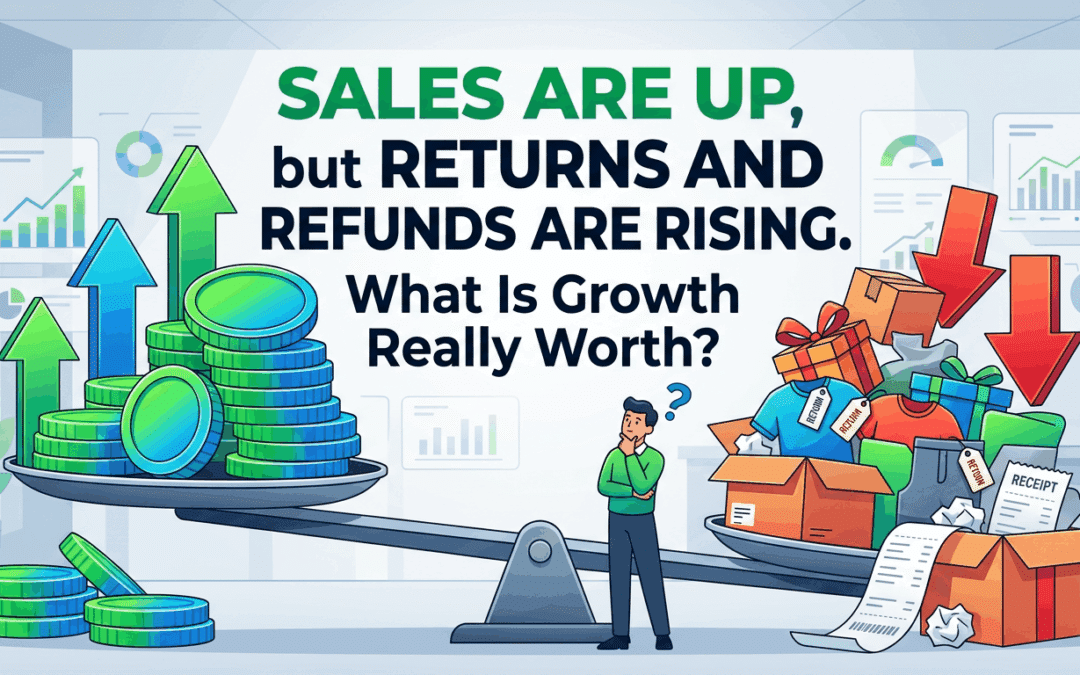
The monthly sales report looks encouraging. Orders have increased, the latest promotion attracted new customers, and revenue before returns is ahead of the previous period. The team has worked hard, and the business appears to be growing.
Elsewhere in the company, the picture is less comfortable. Customer service is handling more complaints, warehouse employees are inspecting returned goods, and finance is processing a growing number of refunds. Some products can be resold, while others need repairs, repackaging, or disposal.
For the owner, the question becomes more complicated than whether sales have increased. How much of that growth remains after the business absorbs the cost of reversing or correcting those transactions?
Returns and refunds are a normal part of many businesses. They do not automatically indicate a serious problem. However, when they rise faster than sales or repeatedly affect particular products, they deserve closer attention. Understanding their full effect helps management distinguish sustainable growth from additional activity that produces little financial benefit.
Start by Understanding What the Sales Report Measures
The word “sales” can mean different things across a business. A marketing dashboard may show order value, an operations report may track dispatched goods, and the accounts may report revenue after relevant adjustments.
Those figures serve different purposes, but comparing them without understanding their definitions can create confusion. A campaign might generate substantial orders that are later cancelled, partially refunded, or returned.
Management should establish which measure is being used when growth is discussed. Does it include cancelled transactions? Have refunds been deducted? Are expected returns reflected where required by the applicable accounting framework?
A clear starting point prevents departments from presenting different versions of success. It also helps owners ask the more useful question: how much value did the business retain from the additional sales?
Higher Return Volumes Do Not Always Mean a Higher Return Rate
If sales double, the number of returns may increase even when the proportion returned stays the same. Management should therefore examine return rates alongside absolute volumes.
Suppose a business previously fulfilled 1,000 orders and received returns relating to 50 of them. If it later fulfils 2,000 orders and receives returns relating to 100, the order-based return rate remains 5 per cent.
The operational workload has still increased, but the proportion has not deteriorated. That situation differs from receiving returns on 200 of the 2,000 orders.
The measure also needs a consistent definition. A rate based on orders can differ from one based on units or sales value, particularly when customers buy several items or return expensive products. Management should select measures suited to the business and explain what each captures.
A Simple Example Shows How Growth Can Lose Value
Consider two illustrative batches of sales after their return periods have finished. Assume the first batch generated S$100,000 before refunds, with S$5,000 refunded to customers. The retained sales amount is S$95,000.
A later batch generates S$120,000 before refunds, but refunds rise to S$15,000. The retained sales amount is S$105,000. Headline sales have increased by 20 per cent, while retained sales have increased by approximately 10.5 per cent.
Now assume product costs, after appropriate adjustments for recoverable returned stock, are S$60,000 for the first batch and S$66,000 for the second. Contribution before additional return-handling costs rises from S$35,000 to S$39,000.
If collection, inspection, repackaging, and other additional return costs increase from S$2,000 to S$7,000, the remaining contribution falls from S$33,000 to S$32,000.
These simplified figures exclude overheads, tax, and other items. They demonstrate how more sales can produce less contribution once the consequences of those sales are considered. The calculation must also avoid counting the same cost or stock loss twice.
Count the Work That Happens After the Refund
The refund amount is usually visible. The associated work may be spread across several departments and receive less attention.
A returned item may require a customer service exchange, a collection booking, warehouse receipt, inspection, and an accounting adjustment. If the product is suitable for resale, employees may also need to clean, test, repackage, and relabel it.
Some of this work may be absorbed by existing staff without an immediate increase in payroll. Even then, it uses capacity that could have supported other customers or ordinary operations.
Management should distinguish between additional cash expenditure and employee time redirected to returns. Both matter, but they should not be treated as identical financial amounts. A useful review shows how returns affect spending, workload, and the ability to fulfil new orders reliably.
Separate Returns, Refunds, Replacements, and Cancellations
Different customer outcomes can create different financial effects. A cancellation before dispatch may avoid delivery costs, while a return after installation may require collection and substantial remedial work.
A replacement might preserve the original sale but require another product and a second delivery. A partial refund could resolve a complaint while leaving the customer with the goods. A warranty repair raises different considerations from an ordinary change-of-mind return.
Combining everything under one broad “returns” category makes it harder to identify the real problem. Management should be able to see what happened and what it cost to resolve.
The categories should remain practical enough for staff to use consistently. A detailed system provides little benefit if employees select the first available option because the definitions are unclear.
Investigate Why Customers Are Returning Products
A refund tells management that a transaction changed. The reason explains what the business may need to improve.
Products might arrive damaged, differ from their descriptions, fail to fit, or be delivered too late for the customer’s intended use. Some customers may order several alternatives with the intention of keeping only one.
These situations require different responses. Better packaging will not resolve an inaccurate size guide, and changing the return policy will not correct a defective production batch.
Useful reason codes should be supported by customer comments, inspection findings, or other available evidence. Staff should also be able to record uncertainty rather than forcing every case into a misleading category. The aim is to understand recurring patterns well enough to take effective action.
Match Returns to the Sales That Generated Them
Returns often occur after the period in which the original transaction took place. Comparing this month’s refunds only with this month’s sales can therefore give a distorted impression.
A successful December promotion may generate returns in January. Looking at each month separately could make December appear unusually strong and January unusually weak, even though both reflect the same campaign.
Management can improve its analysis by linking returns to the original order date, product, and campaign. It should also recognise that recent sales have had less time to generate returns than older sales.
Where comparisons use groups of orders, allow a similar period for returns to develop or clearly identify the difference. Otherwise, an apparently improving rate may simply reflect incomplete information.
Look at Products and Channels Individually
A company-wide average can conceal a concentrated problem. Most products may perform well while a small number account for a disproportionate share of refunds.
The same applies to sales channels. A product sold through a detailed consultation may have a different return pattern from the same product promoted through a short online advertisement.
Management should examine the combinations that matter, such as product, channel, campaign, delivery provider, and supplier batch. This can reveal whether the issue is broad or limited to a specific part of the operation.
The analysis should avoid blaming a team based on raw totals alone. A high-volume channel will naturally generate more cases, so both the proportion and financial impact need to be considered.
Review What the Business Promises Before the Sale
Returns can begin with expectations formed before a customer places an order. Product descriptions, photographs, delivery estimates, and sales conversations all influence what the customer believes they are buying.
A promotion that overstates performance may attract orders while also creating disappointment. An unclear compatibility statement can lead customers to buy something unsuitable even when the product itself works correctly.
Management should compare the sales message with the actual product and delivery experience. Customer service feedback can be especially useful because it shows where expectations repeatedly diverge from reality.
Improving these details may reduce avoidable returns without making the purchasing experience less convenient. The goal is to help customers make informed choices that are more likely to remain successful after delivery.
Assess Returned Stock Before Treating It as Available Inventory
Receiving a product back does not automatically mean it can be sold again at its original price. Its condition, packaging, completeness, and remaining commercial life all matter.
A sealed item may be ready for resale after inspection. Another may need repair or a discount, while a personalised product may have little value to another customer.
The warehouse and finance teams should share information about these outcomes. Otherwise, the system may show goods as available even though they are damaged, incomplete, or awaiting assessment.
A clear process should identify who inspects returns, how their status is recorded, and when a decision is made. Leaving items indefinitely in an unreviewed returns area can obscure both stock availability and the cost of the problem.
Make Sure the Financial Reporting Reflects Return Obligations
For sales within the applicable IFRS 15-based revenue framework that include a right of return, accounting involves more than waiting for cash refunds to occur. Revenue reflects the amount the business expects to be entitled to, with a refund liability and an appropriate asset for the right to recover products where applicable.
These estimates require review as expectations change. Recoverable products also need to reflect expected recovery costs and potential reductions in value.
Different arrangements, including certain exchanges and defective-product replacements, can require different treatment. Finance should assess the actual terms and applicable requirements rather than apply one entry to every customer complaint.
Reliable operational information supports these assessments. Missing return requests or unprocessed credit notes can leave the accounting team without a complete picture of outstanding obligations.
Include Refunds in the Cash Outlook
A business may receive customer payments well before returns occur. If that cash has already been committed to suppliers, payroll, or another campaign, a concentration of refunds can create pressure.
Management should consider likely refund timing when reviewing available cash. This is particularly relevant after a major promotion or when a product problem affects many customers at once.
Payment processing arrangements also matter. The business should understand whether original fees are recoverable and whether refunds, disputes, or replacements generate additional charges under its agreements.
A strong cash balance immediately after a sales campaign does not necessarily represent money free of further commitments. Forecasting expected outflows helps management avoid spending on the assumption that every receipt will be retained.
Improve the Cause Before Tightening the Policy
When refunds increase, making returns harder can appear to be the quickest response. However, a restrictive process may leave the original product or service problem unresolved and create further customer frustration.
Management should first understand which cases are avoidable and what is causing them. Better quality checks, clearer descriptions, appropriate packaging, or more reliable fulfilment may address the issue more directly.
Any review of the return policy should take account of contractual commitments and applicable customer rights. Changes should be clearly communicated and should not depend on staff applying inconsistent rules.
The business also needs to recognise the value of fair resolution. A reasonable response can preserve a customer relationship, even though the individual transaction carries an additional cost.
Evaluate Campaigns on What They Leave Behind
Marketing performance should not end with the number of orders placed. A fuller review considers cancellations, refunds, retained sales, product costs, and the cost of handling problems.
A campaign attracting customers whose needs do not match the offer may generate impressive initial figures but weak final results. Another campaign may bring fewer orders with better margins and fewer complaints.
Management can use this information to refine targeting, product selection, and promotional claims. It can also decide whether a discount remains worthwhile after the additional demand and return workload are considered.
The aim is to understand the quality of the growth. Sales volume remains useful, but it becomes more informative when viewed alongside what the business ultimately keeps.
Give the Improvement Plan Clear Ownership
Returns cross departmental boundaries, making it easy for each team to see only part of the issue. Customer service may identify the complaint, operations may handle the product, and finance may record the refund without anyone connecting the pattern.
A regular review should bring these perspectives together. Significant recurring causes should have an agreed action, responsible person, and date for checking results.
For example, a product with repeated damage reports may require a packaging trial and follow-up on subsequent deliveries. An item with frequent compatibility complaints may need revised product information.
Management should check whether the action reduces the problem without creating another one. A lower return rate is not necessarily an improvement if customers are simply finding it harder to report legitimate issues.
Reliable Records Help Owners Assess the Real Outcome
Understanding returns requires records that connect the original sale with the refund, replacement, recovered goods, and related costs. Without that connection, management may see activity across several systems without understanding its combined effect.
Royal Premier PAC provides accounting and bookkeeping services, including transaction recording, bank reconciliation, and financial reporting. Businesses can discuss how their financial records support management’s assessment of sales adjustments and operating performance.
The scope of any additional reporting should be agreed according to the company’s systems and needs. Operational teams still need to supply accurate information about product condition, customer outcomes, and the reasons behind returns.
A clearer financial picture gives owners a stronger basis for deciding which products, campaigns, and processes deserve further investment.
Measure Growth by the Value the Business Retains
Increasing sales is an achievement, but its financial value depends on what happens after the order is placed. Refunds, replacements, recovery work, and stock losses can change the outcome substantially.
Business owners should examine the rate and causes of returns, connect them to the original sales, and assess their effect on contribution and cash. Where problems are concentrated, focused improvements may protect both profitability and customer experience.
The objective is not to eliminate every return or make every complaint difficult. It is to understand which transactions create lasting value and which repeatedly consume resources without delivering the expected result.
When the business measures growth through retained sales, realistic costs, and customer outcomes, it can make better decisions about what to expand. More activity becomes worthwhile when it supports a stronger business after the refunds have been processed and the work is complete.
Recent Comments