
A Perfect Count Does Not Automatically Mean a Perfect Inventory Balance
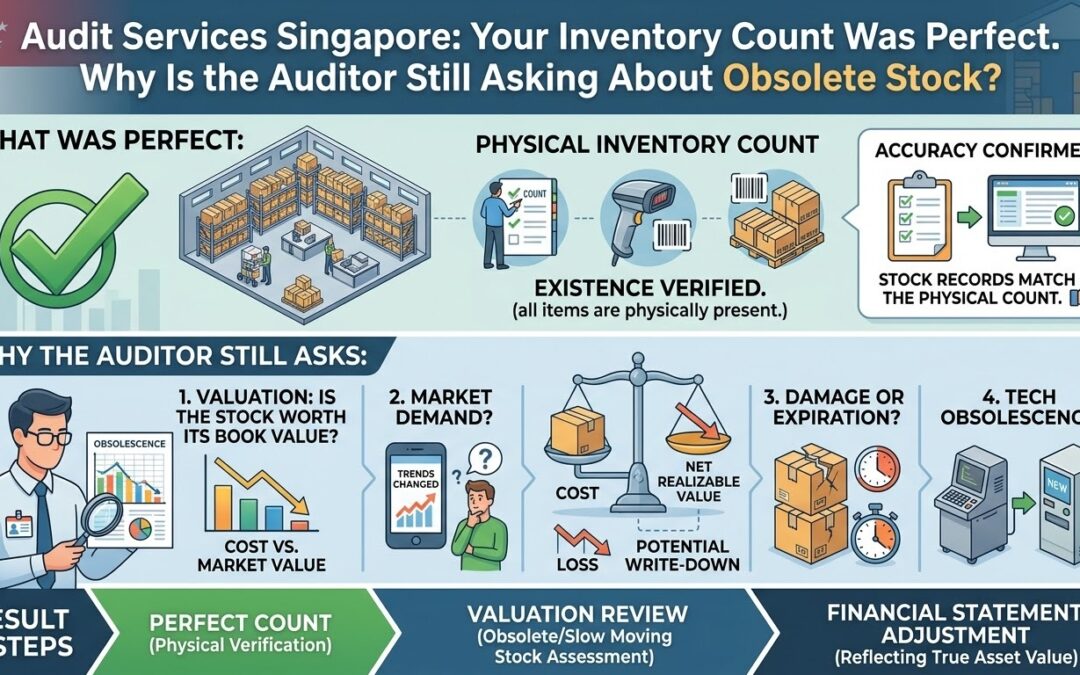
Your warehouse team has spent the entire day counting inventory. Every carton has been checked, every shelf has been labelled, and every difference between the physical count and the inventory system has been investigated. By the end of the exercise, management receives the result it wanted to hear: the physical inventory agrees with the records. There are 10,000 units in the system and 10,000 units physically sitting in the warehouse. It feels like the inventory section of the audit should now be straightforward. Then the auditor starts asking a completely different set of questions. When was this stock last sold? Are customers still buying it? Has the selling price fallen? Are there damaged items? Are some products being replaced by newer models? Management may reasonably wonder why these questions matter when the count was already perfect. The answer is that a physical count primarily helps establish whether inventory exists and whether records reflect the quantities on hand. It does not, by itself, prove that every item is still worth the amount recorded in the accounts.
Counting Inventory Answers Only One Part of the Question
Imagine a company purchased 1,000 units of a product at S$100 each. The warehouse team counts exactly 1,000 units, meaning the physical quantity agrees perfectly with the records. However, suppose the product has become outdated and customers are now willing to pay only S$60 per unit. The physical count can still be 100% accurate while the accounting value of the inventory requires attention. This distinction is central to understanding why auditors do more than observe stock counts. Singapore financial reporting principles require inventory to be considered at the lower of cost and net realisable value, rather than assuming that historical purchase cost will always remain recoverable. For businesses looking for audit services Singapore, understanding this difference can make the year-end audit much easier because management knows why the auditor may continue asking questions after the warehouse count has already been completed successfully.
Inventory Can Exist Without Being Worth Its Original Cost
Physical existence and financial value are different concepts. A warehouse can contain thousands of perfectly real products that have lost part of their economic value. A retailer may still have last year’s fashion collection after customer preferences have changed. An electronics distributor may hold an older model after the manufacturer releases a significantly improved replacement. A food business may have products approaching expiry. An industrial supplier may have specialised components purchased for a customer that no longer needs them. None of these situations means the inventory disappeared. The stock is physically present and can be counted, photographed and inspected. The accounting question is whether the company can still recover the recorded amount through sale or use. This is why a successful stock count should be viewed as one important part of inventory reporting rather than the final answer to every question about inventory.
What Does Obsolete Inventory Actually Mean?
Obsolete inventory is stock that has become difficult, unlikely or potentially impossible to sell or use in the normal course of business because demand, technology, product specifications, customer preferences or other circumstances have changed. Obsolescence does not always mean an item has become completely worthless. A product originally expected to sell for S$200 might still find a buyer at S$120. Another product may need to be heavily discounted before customers become interested. Some stock may eventually be sold to a clearance buyer, recycled, repurposed or disposed of. The financial reporting question therefore involves understanding what value can realistically be recovered. ACRA’s historical audit-quality observations specifically identified inadequate assessment of inventory obsolescence and inadequate work around whether inventory should be written down to net realisable value as weaknesses requiring attention.
Slow-Moving Inventory Is Often the First Warning Sign
One of the first things an auditor may request is an inventory ageing report. Management might initially wonder why the age of an item matters if the product remains perfectly usable. Ageing is useful because inventory that has remained unsold for an unusually long period can indicate declining demand. If a company normally sells its products within 90 days but some items have been sitting in the warehouse for 700 days, the auditor will naturally want to understand why. Perhaps those products are specialised spare parts that customers purchase only occasionally, in which case their age may be reasonable. Perhaps they are seasonal products expected to sell during a future cycle. On the other hand, perhaps customers have simply stopped buying them. Ageing does not automatically prove that inventory is obsolete, but it helps identify items that deserve further investigation rather than assuming every unit has the same recoverability.
Not Selling Something for Two Years Does Not Automatically Make It Worthless
It is equally important not to oversimplify the analysis. An old inventory item is not automatically obsolete. Consider a distributor of specialised machinery parts. A particular component may not have been sold for 18 months, yet customers operating older machines may still require that component when repairs are needed. The company may deliberately maintain a small stock because the item remains commercially useful even though turnover is slow. Compare that with a mobile-phone accessories retailer holding cases designed exclusively for a model that has largely disappeared from the market. Both products may be two years old, but their economic circumstances are very different. ACRA’s previous audit guidance on inventory obsolescence similarly noted that the nature of inventory matters, with products exposed to rapid technological change potentially facing higher obsolescence risk than generic items with longer useful commercial lives. Good inventory analysis therefore requires judgement rather than applying a mechanical rule based solely on age.
The Auditor May Ask to See What Happened After Year-End
One particularly useful source of evidence is what happened to the inventory after the financial year ended. Suppose a company records an item at S$100 per unit on 31 December. During January and February, it sells substantial quantities for S$120. Those subsequent sales may provide useful evidence about the recoverability of the year-end inventory. Now consider another item also recorded at S$100. In January, management launches a clearance sale and can move the stock only after reducing the selling price significantly. That subsequent information may prompt questions about whether the amount recorded at year-end was recoverable. This is why an auditor may request sales invoices dated after the reporting date even though the audit concerns the previous financial year. The auditor is not accidentally auditing the wrong period. Later transactions can provide evidence about conditions relevant to the value of inventory held at year-end.
A Discount Is Not Automatically Evidence of a Problem
Businesses discount products for many reasons, so auditors should not treat every sale below the normal retail price as proof of obsolescence. A company may run a temporary promotion, offer volume discounts to major customers or reduce prices as part of a marketing campaign. The relevant question is whether the expected selling price, after considering costs necessary to complete and sell the inventory, supports the amount at which the inventory is carried. Singapore financial reporting guidance describes net realisable value in terms of the estimated selling price in the ordinary course of business after relevant costs associated with completing and selling the inventory. Management therefore needs to understand the commercial circumstances behind pricing rather than simply telling the auditor that a discount was “normal”.
The Purchase Price Is History, Not a Guarantee of Today’s Value
Business owners sometimes look at an inventory item costing S$80 and instinctively conclude that it is worth S$80 because that is what the company paid. The purchase invoice certainly provides evidence of cost, but it does not guarantee future recoverability. Markets change after purchases are made. Competitors introduce alternatives, customer preferences shift, technologies improve and economic conditions affect demand. A product that was a sensible S$80 purchase twelve months ago may now be difficult to sell for S$80. This is why inventory accounting cannot rely exclusively on purchase invoices. The amount originally paid answers the question of cost, while management must also consider whether the expected economic recovery continues to support that amount. Where net realisable value falls below cost, inventory may require a write-down.
Technology Can Make Perfectly New Products Obsolete Surprisingly Quickly
Technology businesses provide some of the clearest examples of inventory obsolescence. Imagine a distributor holding 500 units of an electronic product that remains unopened and physically perfect. There is no damage, no missing stock and no counting discrepancy. Then the manufacturer releases a replacement offering better performance at the same retail price. Customers rapidly move towards the new model, forcing distributors to discount the older version. Nothing physically happened to those 500 units, yet their commercial value changed. This is why inventory condition cannot be assessed only by looking for broken packaging or visible damage. ACRA’s earlier audit observations specifically identified electronics such as computers and mobile phones as examples where rapid technological change can increase obsolescence risk.
Fashion, Seasonal and Consumer Products Face a Different Kind of Risk
Not every obsolete product becomes obsolete because of technology. Fashion and seasonal businesses can face the same issue because customer demand moves quickly. Christmas merchandise can be perfectly usable in January but difficult to sell at its previous price for another eleven months. A fashion retailer may hold garments in excellent condition that customers no longer want because trends have changed. A promotional product may carry branding linked to an event that has already passed. Businesses operating in these sectors therefore need inventory policies that reflect the commercial life of their products rather than relying solely on physical condition. The faster customer preferences change, the more important it becomes for management to monitor ageing, sales velocity and discounting throughout the year rather than discovering excess stock only when the auditor asks about it.
Damage Can Reduce Value Without Making Inventory Unsellable
Physical condition still matters, of course. During an inventory count, auditors and management may notice damaged packaging, corrosion, moisture exposure, broken seals, scratches or other signs that an item is no longer in its original condition. Some damaged stock may still be saleable, but only at a discount. Other stock may require repairs, repackaging or additional processing before it can be sold. The financial impact depends on the circumstances. A company should therefore avoid assuming that inventory is worth full cost simply because it can technically still be sold. If additional expenditure is necessary or customers will pay less because of the condition, those factors may affect the amount expected to be recovered. A good stock count therefore includes not only counting boxes but also paying attention to what is actually inside the warehouse and whether unusual physical conditions indicate valuation risk.
High Inventory Levels Can Hide Behind Strong Revenue Growth
Obsolescence risk can develop even while the company appears to be growing. Imagine sales increase from S$8 million to S$10 million, which looks encouraging, while inventory rises from S$1 million to S$3 million during the same period. Management may focus on the 25% revenue growth and overlook the fact that inventory increased far more quickly. Perhaps the company intentionally stocked up for future demand, but perhaps purchasing has exceeded actual sales. The auditor may therefore compare inventory movements with revenue, turnover rates and prior periods to identify unusual patterns. A growing inventory balance is not automatically a problem, but management should be able to explain why it grew and whether the stock continues to move at the expected rate. Businesses should be particularly careful when growth in inventory repeatedly outpaces the growth in sales.
Buying in Bulk Can Create Savings and Obsolescence at the Same Time
Purchasing teams often receive attractive volume discounts. A supplier might offer a product at S$90 instead of S$100 if the company purchases 10,000 units. On paper, the business saves S$100,000 immediately. However, the saving matters only if the company can actually sell or use those units. If 3,000 units remain unsold years later and require heavy discounting, part of the original purchasing advantage may disappear. This is an important reason inventory management should not be evaluated only by unit purchase cost. Procurement, sales and finance need to consider demand, storage costs, product life cycles and potential obsolescence together. The cheapest unit price can become expensive when it creates excess inventory that ties up cash and later requires a write-down.
Obsolete Inventory Is Also a Cash Flow Problem
Inventory is not merely an accounting number. It represents cash that the business has already spent. A company may show S$2 million of inventory on its balance sheet, but if S$500,000 consists of products that customers rarely buy, that portion of the company’s working capital is effectively trapped in the warehouse. The business may then need additional financing to purchase newer products while old stock continues occupying storage space. This is why inventory ageing should interest management even outside the annual audit. Identifying slow-moving stock early gives the business more options, such as adjusting prices, reducing future purchases, bundling products, approaching alternative customers or changing sales strategies before the inventory becomes even harder to recover.
Management Should Not Wait for the Auditor to Identify Old Stock
The annual audit should not be the first time anyone asks which inventory has not moved for twelve months. Management has much better access to sales trends, customer behaviour, purchasing plans and product knowledge than the external auditor. Finance can work with sales, procurement and warehouse teams to review ageing reports periodically and identify products that may require commercial action or accounting consideration. This also makes the audit more efficient because management can explain its methodology and provide evidence supporting its assessment rather than reacting to questions after year-end. A strong inventory review process demonstrates that management understands both the quantity and economic condition of the assets it reports.
A Provision Policy Should Reflect the Business, Not Just a Spreadsheet Formula
Some companies use ageing formulas to estimate inventory obsolescence, such as applying increasing percentages to items that have not moved for certain periods. Such policies can provide useful structure, but they should not replace judgement. A blanket formula may be too aggressive for long-life industrial spare parts and too optimistic for rapidly changing consumer electronics. Management should consider historical sales, subsequent sales, product life cycles, current selling prices, future demand, customer contracts and other relevant evidence. The objective is not to produce the most complicated spreadsheet possible. It is to establish a reasonable and supportable assessment of whether inventory remains recoverable at its recorded amount.
Writing Down Inventory Does Not Mean the Warehouse Made a Mistake
Inventory write-downs can sometimes create tension between finance and operational teams because they are interpreted as criticism. The warehouse may insist that all goods are present and properly stored. Procurement may argue that the original purchase decision was commercially reasonable. Sales may believe the products can still be sold eventually. All of those statements can be true while a valuation adjustment is still appropriate. A write-down is an accounting response to current expectations about recoverability, not necessarily an accusation that someone mishandled the inventory. Separating these issues can help management have a more productive discussion about stock value rather than turning the assessment into a debate about responsibility.
The Auditor Will Want Evidence Behind Management’s Assessment
Management may tell the auditor, “We believe all the stock can still be sold.” The auditor then needs to understand the basis for that conclusion. Evidence might include recent sales at prices supporting the recorded amount, customer orders, historical turnover patterns, contracts, current price lists or other relevant commercial information. Conversely, repeated discounting, long periods without sales or newer replacement products may raise further questions. ACRA has previously emphasised that auditors should perform and document appropriate work supporting inventory valuation, including consideration of whether write-downs and obsolescence allowances are necessary. This explains why management’s confidence alone does not end the discussion.
Audit Services Singapore Should Consider Quantity and Value Together
When businesses think about audit services Singapore, inventory counting is often one of the most visible audit procedures because employees physically see auditors in the warehouse observing counts. Yet inventory auditing extends beyond what happens during that visit. Financial statements must comply with applicable accounting standards and give a true and fair view of the company’s financial position and performance. For inventory, that means the auditor may need evidence relating to quantities, ownership, cut-off, costing, condition and valuation. A perfectly executed physical count is valuable, but it cannot answer every one of those questions. The number of units and the value assigned to those units must ultimately make sense together.
Royal Premier PAC Brings Industry Experience to Inventory Audits
Royal Premier PAC provides audit and assurance services to businesses across industries including retail, wholesale and distribution, manufacturing, industrial companies, logistics, investment companies and group companies. Its audit offering includes statutory audits, financial statement audits, internal audits, gross turnover audits, grant audits and other assurance engagements. This industry exposure matters because inventory risk does not look identical across every business. A retailer holding seasonal consumer goods faces different commercial realities from an industrial company holding specialised components, while a distributor of fast-changing products may need to think about obsolescence differently from a company whose stock remains usable for many years.
Good Audit Preparation Starts With Better Inventory Information
Businesses can make the audit process more efficient by maintaining useful inventory information throughout the year. A reliable inventory listing should allow management to understand quantities, costs, ageing and movements rather than merely producing a total balance at year-end. Significant slow-moving items should be investigated before the audit begins, and management should document why older inventory remains recoverable where appropriate. Subsequent selling prices can be reviewed, damaged stock can be identified separately and unusual purchasing patterns can be investigated. These steps are not simply about making the auditor’s work easier. They provide management with better information about where working capital is sitting and whether purchasing decisions remain aligned with actual demand.
A Perfect Count Can Still Reveal an Imperfect Business Decision
There is an interesting commercial lesson hidden inside the audit question. Suppose the auditor confirms that all 20,000 units exist, but discovers that 7,000 have barely moved for two years. The accounting discussion may focus on valuation, but management should ask a broader question: why did the company end up with so much slow-moving stock in the first place? Perhaps purchasing forecasts were too optimistic, sales projections were not updated, minimum order quantities were too high or nobody was responsible for reviewing ageing. The audit does not replace management’s responsibility to solve these commercial issues, but audit questions can highlight areas worth investigating. Royal Premier itself notes that financial statement audits can provide business owners with insights into areas such as inventory levels, reconciliations and financial processes rather than being viewed purely as annual compliance exercises.
The Best Time to Find Obsolete Stock Is Before Year-End
Waiting until the final inventory count to think about obsolescence limits management’s options. If slow-moving products are identified six months earlier, the business may still have time to promote them, negotiate returns with suppliers, bundle them with popular products, reduce future orders or find alternative markets. By year-end, the discussion may have shifted from preventing excess inventory to deciding how much of the recorded amount remains recoverable. Regular inventory reviews therefore serve both accounting and commercial purposes. Finance obtains better evidence for valuation, while operations gain earlier warning that purchasing or sales assumptions may need to change.
Conclusion: The Count Can Be Perfect While the Value Is Still Wrong
A perfect inventory count is good news, but it proves less than many business owners initially assume. It can provide strong evidence that the quantities recorded by the company correspond with stock physically present, yet it does not establish that every item remains worth its original cost. Products can become slow-moving, damaged, technologically outdated, commercially unfashionable or difficult to sell even while they remain physically untouched on the warehouse shelf. Singapore financial reporting principles require inventory valuation to consider the lower of cost and net realisable value, which is why the auditor may review ageing, subsequent sales, selling prices and evidence of obsolescence after the physical count has finished. The auditor is therefore not questioning the warehouse team’s ability to count. The auditor is answering a different question about whether the financial statements appropriately reflect what that stock is economically worth.
Royal Premier PAC Can Help Businesses Approach Inventory Audits With Greater Clarity
For companies seeking audit services Singapore, understanding the purpose behind audit procedures can turn year-end questions from frustration into useful financial insight. Royal Premier PAC’s audit services cover financial statement and statutory audits as well as internal, compliance and specialised assurance work, with services tailored to businesses across a range of industries. When inventory represents a significant part of the balance sheet, the discussion should go beyond whether every box was counted. Management should also understand how quickly products are moving, whether current selling prices support their carrying amounts, where obsolescence risks are developing and how much cash may be tied up in stock that is becoming increasingly difficult to sell. A reliable inventory figure should tell stakeholders not only what is physically inside the warehouse, but also provide an appropriate financial representation of its value.
Recent Comments