
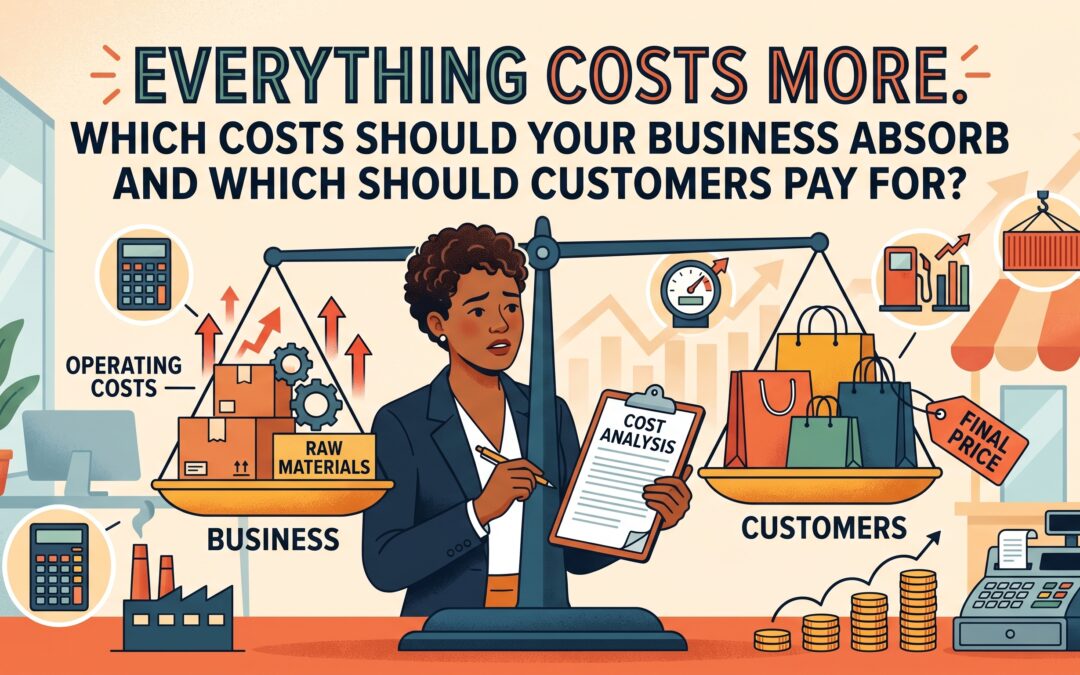
Rising Costs Create a Pricing Question That Every Business Eventually Has to Answer
A supplier increases prices by 8%. Rent rises when the lease is renewed. Employee salaries need to remain competitive. Delivery charges become more expensive, software subscriptions increase and professional fees continue to accumulate. Individually, each increase may appear manageable, but together they can significantly change the economics of a business. Management then faces an uncomfortable decision: should the company absorb the additional costs and accept a lower profit margin, or should some of those costs be passed to customers through higher prices? Neither answer is automatically correct. Raising prices too aggressively can damage customer relationships and reduce demand, while absorbing every increase can gradually destroy profitability. The challenge is determining which costs represent temporary pressure, which reflect permanent changes in the cost structure and how much customers are genuinely willing to pay. For many businesses, the right response will involve a combination of pricing changes, productivity improvements, supplier negotiations and deliberate decisions about which costs the company should continue absorbing.
A S$1 Million Cost Increase Does Not Always Arrive as One Big Problem
Imagine a Singapore business generating S$20 million in annual revenue. Last year, its total operating costs were S$17 million, leaving S$3 million before other relevant items. This year, nothing dramatic happens. There is no single crisis and no supplier suddenly demands another S$1 million. Instead, payroll increases by S$300,000, materials cost another S$250,000, rental and utilities rise by S$100,000, logistics add S$120,000, technology subscriptions increase by S$80,000 and numerous smaller expenses add another S$150,000. Suddenly, the company has approximately S$1 million of additional annual expenditure. If revenue and pricing remain unchanged, a significant portion of the previous margin disappears. This is why management should not wait for a dramatic cost shock before reviewing profitability. Hundreds of individually understandable increases can collectively become a major strategic problem.
Absorbing Every Increase Can Quietly Destroy a Healthy Margin
Businesses sometimes avoid raising prices because management fears upsetting customers. The company absorbs a supplier increase this month, a wage increase next quarter and a higher logistics charge later in the year. Customers see no change, sales remain stable and management initially feels the strategy is working. The financial impact, however, accumulates quietly. A business earning a 15% margin may eventually find itself earning 10%, then 8%, without experiencing any obvious collapse in revenue. At that point, substantially more sales may be required merely to generate the same absolute profit the company previously earned. Absorbing costs is therefore not free. It is effectively a decision for shareholders or owners to pay for part of the customer’s product or service through lower profitability. There may be good strategic reasons to do that temporarily, but management should recognise it as a deliberate investment rather than allowing margins to deteriorate unnoticed.
Passing Every Increase to Customers Can Be Just as Dangerous
The opposite strategy can also fail. A business cannot necessarily increase prices every time one of its expenses rises. Customers purchase based on the value they receive and the alternatives available to them, not according to the supplier’s internal cost structure. If a company’s rent rises because it chose a more expensive office, customers may reasonably ask why they should pay for that decision. If poor procurement causes material costs to be higher than competitors’, passing the entire difference to customers can make the company less competitive. Pricing therefore cannot be managed using a simple formula where every 5% increase in costs automatically produces a 5% increase in selling prices. Management needs to understand the market, customer sensitivity, competitive alternatives and the value of what it sells. Cost information tells a company what it needs economically, but the market ultimately determines what it can charge.
Start by Separating External Cost Pressure From Internal Inefficiency
One of the most useful distinctions is whether a cost increase is largely outside the company’s control or caused by how the company operates. If the market price of a critical raw material rises significantly across the industry, competitors may face similar pressure, making some level of price adjustment easier to justify. If costs increase because employees repeatedly work overtime due to poor scheduling, that is a different problem. Customers should not automatically be expected to fund inefficiency. The same principle applies to duplicate software, unnecessary management layers, avoidable wastage, weak purchasing controls and processes that require excessive manual work. Before asking customers to pay more, management should examine whether the company has done enough to control the costs it can influence. A price increase is much easier to defend internally when management knows it is not simply transferring avoidable inefficiency to customers.
Supplier Increases Need More Than an Automatic Acceptance
When a supplier announces a 10% increase, the purchasing department may feel it has only two choices: accept the increase or find another supplier. In reality, there may be more room for discussion. Management can examine whether volume commitments could improve pricing, whether specifications can be adjusted, whether purchases can be consolidated, whether alternative suppliers exist or whether payment terms can be renegotiated. A long-standing supplier relationship should not mean prices are never challenged. At the same time, changing suppliers solely to obtain the lowest price can create quality, reliability and operational risks. The objective should be to understand whether the new price reflects genuine market conditions and whether the supplier continues to provide appropriate value. Only after examining those questions can management decide how much of the increased cost genuinely needs to flow through the business.
Payroll Is a Cost Increase That Requires a Different Conversation
Employee costs cannot be managed in exactly the same way as raw materials. Salaries may need to increase to retain capable employees, attract scarce skills or reflect expanded responsibilities. Yet management should still examine whether payroll growth is being matched by productivity, revenue capacity or improved service. If payroll rises 15% while output remains unchanged, the company should understand why. Perhaps the business intentionally invested ahead of growth, hired specialists to build a new capability or improved compensation to reduce damaging turnover. Those can be rational decisions. But if payroll is rising because every department automatically replaces employees, organisational layers continue expanding and manual processes require more people each year, the problem may be structural. Passing those costs to customers without addressing productivity can eventually make the business uncompetitive.
Customers Are More Likely to Accept Price Changes When They Understand the Value
A price increase is easier to defend when customers understand why the product or service remains valuable. Businesses sometimes communicate price changes badly, sending a short notice that essentially says costs have increased and therefore prices will rise next month. From the customer’s perspective, that sounds like being asked to solve the supplier’s problem. A stronger approach focuses on the value being maintained or improved. Perhaps the company is protecting service quality, maintaining experienced employees, improving reliability, strengthening technical support or avoiding compromises that would reduce the customer experience. This does not mean every price increase requires a lengthy justification, but management should understand what customers are receiving in return. Businesses with clear differentiation generally have greater pricing flexibility than those competing almost entirely on price.
Not Every Customer Needs to Receive the Same Increase
A blanket 10% price increase is simple to administer, but customer economics are rarely identical. One customer may order large volumes, pay within 14 days, use standard products and require little support. Another may buy the same amount but demand customisation, urgent delivery, extensive account management and 90-day credit terms. If both customers currently receive similar pricing, the second may already be significantly less profitable. A pricing review can therefore be an opportunity to examine customer-level profitability rather than applying the same increase universally. Some customers may justify a smaller adjustment because they are highly efficient to serve, while others may require a larger increase simply to restore a reasonable margin. The objective is not to punish difficult customers. It is to ensure pricing reflects the economic reality of serving them.
The Biggest Customer May Have the Least Room Left in Its Margin
Large customers often negotiate aggressively because they know their purchasing volume gives them leverage. A company may therefore celebrate a S$2 million account while earning a surprisingly small margin from it. When costs increase, management can feel trapped because raising prices risks losing a major customer, while absorbing the increase makes an already thin-margin relationship even weaker. This is where detailed profitability information becomes valuable. Management needs to know the customer’s revenue, direct costs, discounts, rebates, delivery requirements, support burden, payment behaviour and other relevant expenses. The decision should not be based solely on fear of losing S$2 million of revenue. If the account contributes little profit after all costs are considered, preserving the revenue at any price may not be good business.
A Small Price Increase Can Have a Large Effect on Profit
Pricing changes can affect profitability much more significantly than their percentage suggests. Consider a simplified business selling S$10 million annually with S$9 million of total relevant costs, leaving S$1 million of profit. If the company can increase effective selling prices by 3% while sales volume and costs remain broadly stable, that represents approximately S$300,000 of additional revenue. In this simplified example, much of that increase can flow towards profit, potentially producing a substantial percentage improvement in earnings even though customers experienced only a relatively small price adjustment. Real businesses are more complicated because price increases can affect demand, sales mix and variable costs, but the principle remains important. Management should understand that protecting a few percentage points of price can sometimes matter more than chasing a much larger percentage increase in sales volume.
Discounts Deserve the Same Attention as Official Prices
A company may announce a 5% price increase and later discover that realised prices barely changed because salespeople increased discounts to keep customers happy. This is why management should monitor actual selling prices rather than simply reviewing the published price list. Discounts, rebates, promotional arrangements, free delivery, extended credit and complimentary services can all reduce the effective price customers pay. Sales employees may genuinely believe they are protecting important relationships, especially when their performance is measured primarily by revenue. The result can be strong sales accompanied by deteriorating margins. Pricing strategy therefore needs clear authority and visibility. Management should know who can approve discounts, under what circumstances and what happens to profitability when concessions are made.
Some Customers Will Resist Any Increase, but Resistance Does Not Always Mean They Will Leave
Businesses often underestimate their pricing power because customers naturally complain when prices increase. A customer saying an increase is unacceptable is not the same as a customer actually moving to a competitor. Changing suppliers may involve search costs, operational disruption, retraining, quality risks, contractual considerations or uncertainty about service. This does not mean companies should exploit customer dependence. It means management should distinguish between normal negotiation and genuine loss risk. Historical data can help. Which customers reduced purchases after previous increases? Which negotiated but ultimately accepted the new terms? Which products are most price-sensitive? Which relationships depend heavily on service and reliability? Pricing decisions become stronger when they are based on evidence rather than assuming every objection means the customer will disappear.
Lower-Margin Products May Need a Different Strategy
A business with several products or services should not assume cost inflation affects them equally. One product may already generate a healthy margin and have significant pricing power, while another may operate close to break-even. A supplier increase affecting the second product could make it economically unattractive unless prices change. Management then needs to consider whether the product has strategic value, supports sales of more profitable items or serves an important customer relationship. If none of those applies, maintaining an unprofitable product simply because “we have always sold it” deserves scrutiny. Rising costs can expose weaknesses that were previously hidden by better margins elsewhere. Rather than spreading price increases evenly, companies should review profitability at a sufficiently detailed level to understand which activities genuinely need intervention.
Cost Reduction Should Focus on Waste Before Value
When margins are under pressure, companies often announce broad cost controls. Travel is restricted, training is postponed, recruitment is frozen and departments are told to reduce spending. Some discipline may be necessary, but indiscriminate cuts can remove activities that support revenue while leaving structural inefficiency untouched. A better approach asks which spending creates customer value, protects important capabilities or manages significant risk, and which spending exists mainly because nobody has challenged it. Unused software, duplicated processes, unnecessary manual work, poor procurement and repeated administrative tasks are better initial targets than expenditure that directly supports customer experience or future capability. Cost reduction works best when it makes the organisation more efficient, not merely smaller.
Productivity Can Absorb Part of the Increase Without Sacrificing Margin
Businesses often frame the decision as having only two choices: the company absorbs the cost or the customer pays it. There is a third possibility. The organisation can become more productive. Suppose labour and supplier costs add S$500,000 of annual pressure. Process improvements, automation, better purchasing and reduced rework might recover S$200,000. Management could then decide to absorb another S$100,000 strategically while recovering S$200,000 through pricing. No single stakeholder bears the entire increase. This balanced approach is often more sustainable because it recognises that businesses should continually improve their own efficiency while customers may also need to accept reasonable price changes when the economics of providing a product or service have genuinely changed.
Cutting Quality to Avoid Raising Prices Can Become an Invisible Price Increase
Some businesses are reluctant to increase the number on the invoice, so they reduce what the customer receives instead. Portions become smaller, service hours are reduced, cheaper materials are used, response times lengthen or experienced employees are replaced with less costly alternatives. Economically, the customer may still be paying more because the value received has decreased even though the nominal price remains unchanged. Sometimes redesigning a product or service is a sensible response to changing costs, particularly if customers prefer maintaining the existing price point. The danger arises when quality deteriorates unintentionally because management is trying to protect margin without acknowledging the trade-off. Customers may tolerate a transparent price increase better than a gradual decline in quality they did not agree to.
Cash Flow Should Be Considered Alongside Profit Margin
Cost pressure does not affect only the profit and loss statement. Suppliers may shorten payment terms while customers continue requesting longer credit periods. Payroll must still be paid monthly, rent remains due and inventory may need to be purchased before revenue is collected. A company can therefore face growing cash-flow pressure even while remaining profitable. Pricing decisions should consider payment terms as well as headline prices. A customer paying S$100,000 within 14 days may be economically more attractive than one paying S$105,000 after 120 days, depending on the circumstances and costs involved. Businesses should look at the entire commercial arrangement rather than focusing exclusively on the invoice amount.
Temporary Cost Shocks and Permanent Cost Changes Need Different Responses
Management should also consider whether an increase is expected to persist. A temporary disruption may justify absorbing some additional cost to preserve customer relationships, particularly when repeatedly changing prices would create unnecessary instability. A structural increase in wages, rent or long-term supplier pricing requires a different response because absorbing it indefinitely permanently reduces margin. The difficulty is that management rarely knows with certainty whether a cost increase is temporary. Scenario planning can help. What happens if the higher cost remains for three months, one year or permanently? How much margin can the business reasonably absorb under each scenario? Establishing thresholds in advance can prevent management from repeatedly postponing a pricing decision until profitability has already deteriorated substantially.
Pricing Should Not Be Reviewed Only When the Business Is Under Pressure
Many companies pay close attention to costs throughout the year but review prices only when margins become uncomfortable. This creates a reactive cycle where significant increases are eventually required because smaller adjustments were postponed for too long. Regular pricing reviews allow management to examine market conditions, customer profitability, product margins and cost changes before the situation becomes urgent. A company does not necessarily need to change prices every time it performs the review. The value lies in knowing whether current prices still make economic sense. When pricing becomes a regular management discipline rather than an emergency response, businesses can make smaller and more deliberate adjustments.
Management Needs Better Information Than “Costs Are Up”
A statement that costs increased by 8% is not enough to make a good pricing decision. Which costs increased? Were they variable or fixed? Which products were affected? Which customers consume the most resources? Which departments exceeded budget? How much of the increase was expected? How much resulted from higher activity levels? Which costs could be reduced without damaging operations? These questions require reliable management information. Businesses that cannot answer them risk making broad pricing decisions based on incomplete understanding. They may raise prices on profitable products unnecessarily while continuing to underprice activities that are actually causing the problem.
Strong Financial Information Makes the Trade-Off Easier to See
This is where professional accounting and financial reporting remain relevant even in a discussion that appears primarily commercial. Royal Premier Public Accounting Corporation supports businesses in areas including accounting, financial reporting, audit and related professional services. Reliable financial information can help management understand margin trends, expense movements, customer or business-unit performance and other factors influencing profitability. The accountant should not necessarily decide what price the sales team charges. However, management needs trustworthy numbers to understand the consequences of its pricing decisions. A company cannot confidently decide which costs to absorb if it does not know where its margins are being earned or lost.
The Answer Is Usually Not “Customers Pay Everything” or “We Absorb Everything”
A sustainable response to rising costs is often a combination of actions. Management may negotiate with suppliers, eliminate waste, improve processes, automate repetitive work, adjust product specifications, increase selected prices, reduce excessive discounts and deliberately absorb part of the remaining increase. Different customers and products may require different responses. A highly profitable strategic customer may justify temporary absorption, while a chronically low-margin account may need repricing. A temporary logistics surcharge may be treated differently from a permanent wage increase. The objective is to protect the long-term economics of the business while remaining competitive and fair to customers. This requires judgement rather than a universal formula.
The Customer Should Pay for Value, Not for Your Inefficiency
Perhaps the most useful principle is that customers should be willing to pay a price that reflects the value of what they receive, while businesses remain responsible for managing their own operations efficiently. If the genuine economic cost of providing a valuable product has permanently increased across the market, some adjustment in price may be reasonable. If the company’s costs are rising because processes are inefficient, purchasing is weak or management has allowed unnecessary expenditure to accumulate, customers may eventually refuse to fund those problems. The distinction encourages businesses to examine themselves before blaming external conditions. Pricing power is strongest when a company can demonstrate value and operate efficiently at the same time.
Conclusion: Protect the Business Without Forgetting the Customer
When everything costs more, there is no rule saying the business must absorb every increase or pass every additional dollar to customers. Absorbing too much can gradually weaken margins, cash flow and the company’s ability to invest. Passing too much through can damage competitiveness and customer relationships. Management needs to understand what caused the increase, whether it is temporary or structural, which products and customers are affected, how much internal efficiency can offset the pressure and how much pricing power the business genuinely has. The objective is not simply to protect this month’s profit. It is to maintain an economic model that allows the company to continue delivering value to customers while earning enough to invest, employ capable people, manage risks and remain financially sustainable.
The Better Question Is Not Who Should Pay, but How the Business Should Respond
Instead of asking only, “Should we absorb this cost or make customers pay?”, management can ask a more useful question: “What combination of actions keeps this business competitive and profitable?” Part of the answer may come from customers through carefully considered pricing changes. Part may come from suppliers through negotiation. Part may come from employees and technology through better productivity. Part may come from management by eliminating activities that no longer create sufficient value. The company may deliberately absorb the remainder because protecting a strategic relationship or market position is worth more than the immediate margin. Rising costs are therefore not merely an accounting problem or a pricing problem. They are a test of whether management understands how the business creates value, where its money is going and which trade-offs it can afford to make. Businesses that understand those relationships can respond deliberately rather than discovering months later that stable prices have quietly been paid for with disappearing profits.
Recent Comments