
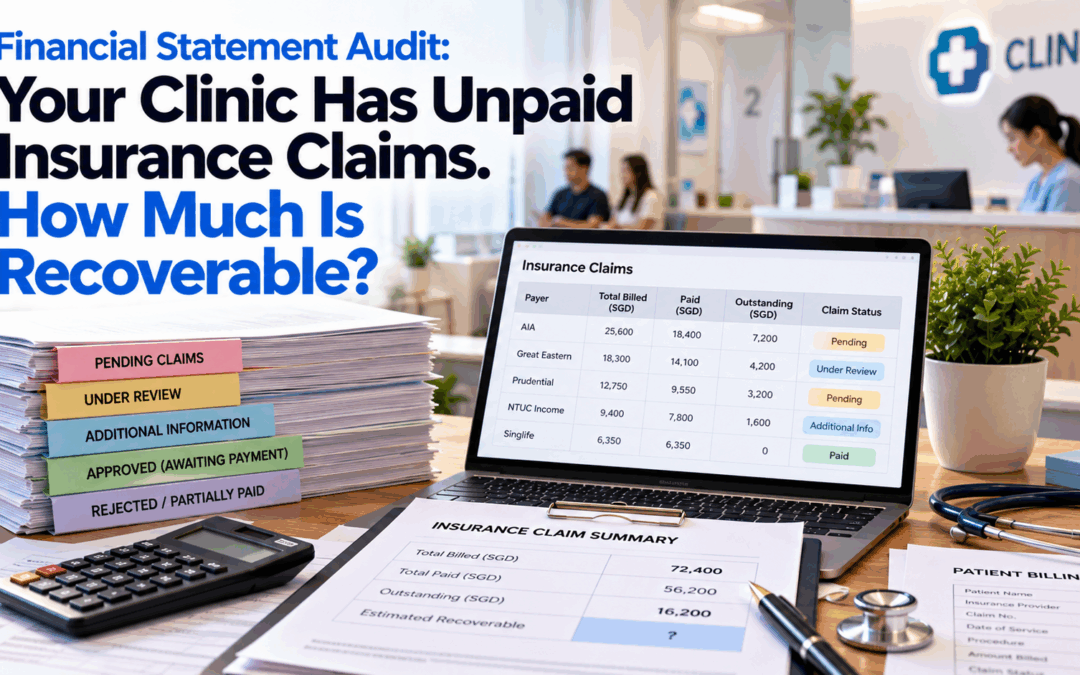
Your clinic has completed the consultations, provided the treatment, and submitted the claims. Yet several months later, part of the money remains unpaid. The claims portal shows a mixture of pending, queried, rejected, and partially settled items, while the accounts still show a substantial receivable.
Management may expect most of that balance to arrive eventually. After all, the services were delivered and the claims were submitted. However, those facts do not establish that every amount recorded is recoverable in full.
During a financial statement audit, the clinic may need to explain who owes each amount, whether the recorded charge reflects its entitlement, and what evidence supports collection. A useful review begins by separating ordinary processing delays from billing errors, contractual adjustments, and genuine credit risk.
Identify Who Is Actually Responsible for Payment
A clinic’s internal report may group everything under “insurance claims,” even when the underlying arrangements differ. Some amounts may be owed by insurers, others by corporate customers, and others by patients. A third-party administrator may process claims without being the party ultimately responsible for paying them.
Review the relevant agreements and billing arrangements. Establish the responsible payer, agreed rates, payment conditions, and any patient contribution. Do not assume that the organisation operating the portal is necessarily the debtor.
For example, a claim submitted through an administrator may relate to an employer-funded programme. The collection assessment should reflect the actual contractual arrangement. Without that distinction, finance may send reminders to the wrong party or assess the wrong organisation’s ability to pay.
Check Whether the Recorded Amount Is Valid
Before estimating a loss allowance, confirm that the receivable itself has been recorded correctly. A clinic’s standard charge may differ from the amount permitted under a panel agreement or another negotiated arrangement.
Compare the invoice with the applicable fee schedule, services delivered, and agreed patient contribution. Check for duplicate submissions, incorrect quantities, and amounts already settled but not matched to the account.
Suppose the clinic records a S$200 consultation charge when the relevant agreement entitles it to S$150. The difference is not automatically a bad debt caused by an insurer failing to pay. It may require correction of the original billing or revenue amount. Establishing the correct entitlement comes before assessing whether that amount will be collected.
Separate Claim Status From Accounting Conclusions
Portal labels are operational information, not complete accounting assessments. “Pending” could mean the claim is within normal processing time, awaiting documentation, or held for a more substantive reason.
Ask the billing team to explain the categories used by each payer or administrator. Record the date of the latest update, any action required, and the evidence supporting the expected outcome.
A claim awaiting a corrected invoice may be resolvable quickly. A rejected claim involving an excluded service presents a different question. Combining both under one pending balance can make the accounts appear more certain than the underlying records justify.
Build an Ageing Schedule That Reflects the Arrangement
An ageing report helps identify older balances, but its usefulness depends on accurate dates and payment terms. Distinguish the service date, invoice date, submission date, and contractual due date where these differ.
For assessing overdue payment, calculate days past due against the relevant terms. For managing claims administration, it may also be useful to track how long an item has remained unsubmitted or unresolved since treatment.
Avoid resetting the history whenever a claim is resubmitted. Retain the original reference and explain the resubmission so that repeated administrative changes do not make an old item appear new. Management should be able to see both the current processing position and the total time the claim has remained outstanding.
Distinguish Billing Adjustments From Credit Losses
Not every reduction in a claim balance has the same accounting cause. A correction to an overstated charge, an agreed price adjustment, and a loss arising from a debtor’s failure to pay can require different treatment.
Consider a claim reduced because a contracted rate was applied incorrectly. Compare that with an accepted, valid amount that remains unpaid because the responsible payer is in financial difficulty. Both reduce expected cash collection, but the underlying issues differ.
Your accountant should assess the appropriate treatment under the applicable reporting framework. Avoid recording every shortfall in a single bad-debt account merely because that is the easiest way to clear the balance. The distinction affects how management interprets revenue, billing quality, and collection performance.
Do Not Automatically Transfer Rejected Claims to Patients
An insurer’s rejection does not necessarily establish that the patient owes the amount. The clinic needs to consider its agreement with the patient, the relevant billing terms, and any restrictions or circumstances affecting recovery.
Check whether the patient accepted responsibility for charges not covered by the arrangement and whether the amount being transferred is valid. Where the position is unclear, obtain appropriate advice before treating a patient balance as an established receivable.
From an accounting perspective, moving a claim into a different customer account does not resolve recoverability. The new classification still needs evidence supporting both entitlement and expected collection. It should not be used simply to remove an old item from the insurer ageing report.
Use Subsequent Receipts Carefully
Payments received after year-end can provide useful evidence about balances outstanding at the reporting date. Match those receipts to the relevant claims rather than relying on a large payment from the same payer as proof that all older amounts are recoverable.
A remittance advice may identify several invoices, partial payments, deductions, and adjustments. Reconcile the allocation and investigate differences before clearing the balances.
For example, a S$20,000 receipt from an administrator might settle recent claims while leaving disputed older claims untouched. The receipt supports collection of the identified items, but it does not automatically support the remainder. Keep the allocation clear enough for another person to follow.
Assess Expected Credit Losses Under the Applicable Framework
For clinics applying IFRS 9 or the corresponding full Singapore requirements, eligible trade receivables without a significant financing component are subject to lifetime expected credit loss assessment under the simplified approach. Confirm the framework and requirements applicable to the clinic.
An ageing-based provision matrix can be a practical method, but the percentages need a supportable basis. Historical experience should be considered alongside current conditions and reasonable, supportable forward-looking information.
Do not wait for a payer to become insolvent before considering credit losses. Equally, an overdue balance does not automatically require a complete write-off. The assessment should reflect the risk and evidence, with separate attention to significant items that are not adequately represented by a general calculation.
Group Balances According to Meaningful Differences
Applying one loss percentage to every receivable can hide different risk characteristics. Patient balances, corporate accounts, and insurer-related balances may have different payment patterns and collection risks.
Consider whether grouping by responsible payer, arrangement, ageing, or another relevant characteristic produces a more meaningful assessment. Keep the method practical and explain why the chosen groups make sense.
Historical losses should also be analysed carefully. If past write-offs included duplicate invoices or charges that were never contractually recoverable, those amounts may not represent credit losses. Correct classification improves the information used to estimate future collection shortfalls.
A Simple Example Shows Why the Breakdown Matters
Imagine a clinic with S$120,000 recorded as outstanding claims at year-end. The following figures are hypothetical and are not suggested provisioning rates or industry benchmarks.
The review identifies S$15,000 of duplicate and incorrectly priced billings requiring appropriate correction. This leaves S$105,000 of valid receivables. Subsequent receipts settle S$75,000 of those balances, while S$30,000 remains unpaid at the time of review.
Assume a documented assessment supports an expected credit loss allowance of S$6,000 on the remaining balances, with no further allowance required on the collected items based on the circumstances. The year-end receivables would therefore be presented at S$99,000 after the billing corrections and loss allowance.
The later S$75,000 collection does not reduce year-end receivables retrospectively. It provides evidence for the year-end assessment and reduces the balance when received. The example illustrates why billing corrections, impairment, and subsequent settlement should be tracked separately.
Investigate Deductions Rather Than Accepting Them Automatically
Partial settlements can contain deductions for several reasons. These may involve contracted rates, administrative charges, disputed services, or other items governed by the arrangement.
Compare each significant deduction with the contract and remittance details. Establish whether the clinic accepts it, needs to correct the original billing, or has grounds to challenge it. Assign responsibility and a follow-up date for disputed amounts.
An unresolved deduction should not remain indefinitely in a miscellaneous account. Nor should every deduction automatically reduce revenue. The correct treatment depends on what the amount represents and the applicable accounting requirements. Preserve the evidence supporting the conclusion.
Connect Billing Records With the General Ledger
A claims portal and a clinic management system may contain information that never reaches the accounting ledger correctly. Reconcile the detailed claim records with the receivables control account at regular intervals.
Check whether credits, refunds, patient payments, and administrator settlements flow through the systems once and only once. Pay attention to manual uploads and integrations that can create duplicate entries or omit adjustments.
For instance, the billing team may mark a claim as settled while finance records the receipt against an unidentified payment account. Unless the records are reconciled, management could continue chasing a paid claim and overstate both receivables and unallocated receipts.
Keep Patient Information Proportionate and Secure
Supporting a balance does not mean circulating complete patient files unnecessarily. Begin with claim references, invoices, contracts, status information, and payment evidence appropriate to the financial question.
Where further information is needed, agree on a secure method and the relevant scope with the audit team. Apply appropriate access controls and consider confidentiality and data-protection obligations when preparing the records.
For routine schedules, coded references can help link documents without exposing more information than necessary. The objective is sufficient audit evidence with an organised, controlled process, rather than an unrestricted export of clinical information.
Prepare Management’s Assessment Before the Audit
Management should prepare the receivables assessment and proposed accounting treatment before asking the auditor to review it. The financial statement audit independently evaluates the evidence; it does not replace the clinic’s responsibility for maintaining records and making supported estimates.
Prepare the detailed ageing, payer agreements, reconciliation, claim-status explanations, subsequent receipts, and allowance calculation. Highlight significant judgements, unresolved disputes, and changes from the previous year.
Explain why management expects material outstanding amounts to be collected. Statements such as “this insurer always pays eventually” are less useful than documented payment patterns, current correspondence, and evidence relating to the claims under review.
Use the Findings to Improve Cash Collection
A year-end review can reveal recurring operational problems. Frequent rejections may point to incomplete submissions, incorrect fee schedules, or unclear responsibility for responding to queries.
Use those findings to improve the process without confusing collection activity with the accounting conclusion. A claim may require an allowance while the clinic continues appropriate recovery efforts. Conversely, active follow-up alone does not justify carrying every balance at full value.
Track unsubmitted claims, queried items, overdue valid balances, and unresolved deductions separately. This gives management a clearer picture of where money is delayed and which actions could improve collection. Assign named owners so that portal updates lead to action rather than another passive status report.
Discuss Receivables Preparation With Royal Premier
Royal Premier PAC provides statutory and financial statement audit services. For a clinic preparing for an engagement, a clear explanation of its billing arrangements and outstanding claims helps the audit team understand the relevant financial reporting risks.
Bring the claim-level records, payer terms, significant correspondence, and management’s assessment to the planning discussion. Identify where contractual entitlement is uncertain and where the concern relates to payment of an otherwise valid amount. These are different questions and should be supported accordingly.
A financial statement audit asks more than whether the clinic submitted its claims. The accounts need to reflect valid amounts and a supportable assessment of what is recoverable. Separating billing accuracy, contractual entitlement, and credit risk gives management a clearer receivables figure and a more useful plan for collecting the money.
Recent Comments